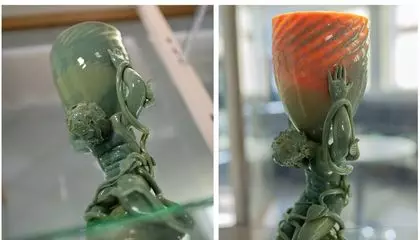
The Romans were ingenious inventors, developing everything from self-healing concrete that helped their structures stand for centuries to gravity-fed aqueducts that carried fresh water into cities. But one of their crowning achievements, at least in the eyes of some modern scientists, was developing color-changing glass that transformed from jade green to blood red in different lightings. For decades, scientists have been inspired and intrigued by the Lycurgus Cup, a 1,600-year-old Roman chalice that’s been housed at the British Museum since 1958.
In normal light, the cup is opaque green. But when light is shone directly thought it, it turns crimson. Made during the fourth century C.E., the cup is decorated with mythological scenes from Homer’s Iliad, the epic poem set during the Trojan War.
It shows Dionysus, the god of wine, punishing Lycurgus, the mortal Thracian king who opposed his worship, by ensnaring him in grape vines. Now, researchers say they’ve figured out how to replicate this optical feat. The Romans are believed to have created the cup’s color-changing effect by embedding tiny nanoparticles of silver and gold in the glass.
Nanoparticles are much smaller than the wavelengths of visible light. Under certain conditions, they interact with light in ways that block some colors while allowing others to pass through. First, Hollands teamed up with Caroline Jackson, an archaeologist and Roman glass expert at the University of Sheffield, to learn as much as she could about the materials.
Together, they used modern materials to recreate a base glass similar to the kind the Romans would have made. Then, Hollands tinkered around with various ingredients and processes—different furnace types, oxygen levels and materials, including sugar—until she came up with a recipe that consistently and repeatedly produced the desired effect with only the raw materials available to Roman artisans. The color of the glass was highly sensitive to small variations in the furnace.
He adds: “The fact that the color is so sensitive to the position in the furnace suggests that it would have been very difficult for the Romans to control the color. It makes me think that, with the Lycurgus glass, they hit the jackpot.” Researchers created a version of dichroic glass in the 1960s. But Hollands’ glass is “more ambitious and more precise,” says Freestone, with colors that more closely match those of the Lycurgus Cup.
Extract — continue reading at the source.