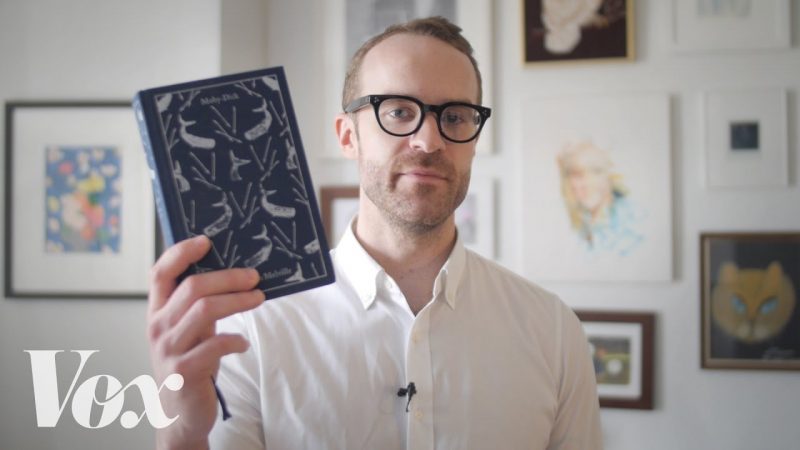
Sometimes, when I can’t sleep, I mentally revisit the various homes of my childhood, wandering from room to room, turning on lights and peering in closets until I conk out. Turns out these imaginary tours are also handy mnemonic tools, as Vox’s Dean Peterson explains above. Hey, that’s good news… isn’t the subconscious rumored to do some heavy lifting in terms of processing information?
Peterson conquered a self-described bad memory, at least temporarily, by traipsing around his apartment, depositing vivid sentence-by-sentence clues that would eventually help him recite by heart one of his favorite chapters in Moby Dick. In truth, he was planting these clues in his hippocampus, the relatively small structure in the brain that’s a critical player when it comes to memory, including the spatial memories that allow us to navigate familiar locations without seeming to give the matter any thought. What made it stick was pairing his everyday coordinates to extraordinary visuals.
Chapter 37, for those keeping track at home, is a monologue for Captain Ahab in which he describes himself as not just mad but “madness maddened.” Here’s the first sentence: I leave a white and turbid wake; pale waters, paler cheeks, where’er I sail. Not the easiest text for 21st-century heads to wrap around, though with a little effort, most of us get the gist. Let’s not get hung up on literary interpretation here, though, folks.
Having settled on his front stoop as the first stop of his memory palace Peterson refrained from picturing frothy spume lapping at the lowermost step. Instead he plunked down a funeral wreath and director John Waters, pale of suit and cheek, weeping. After which Peterson moved on to the next sentence.
There are 38 in all, and after several days of practice in which he mentally walked the image-strewn course of his apartment-cum-Memory Palace, Peterson was able to regale his coworkers with an off-book recitation. The time factor will definitely be a letdown for those hoping for a low-commitment party trick. Peterson spent three-to-four hours a day pacing his spatial memory, admiring the oddities he himself had placed there.
The incredulous comments from those questioning the efficiency of giving up half a day to memorize a page and a half are balanced by testimonials from those who’ve met with success, using the Memory Palace method to retain vast amounts of data prior to an exam. That may, ultimately, be a better use of the Memory Palace. Peterson gets an A for spitting out the lines as written, but his expression is that of an actor auditioning with material he has not yet mastered. (No shade on Peterson’s acting talent or lack thereof—even great actors get this face when their lines are shaky.
Extract — continue reading at the source.