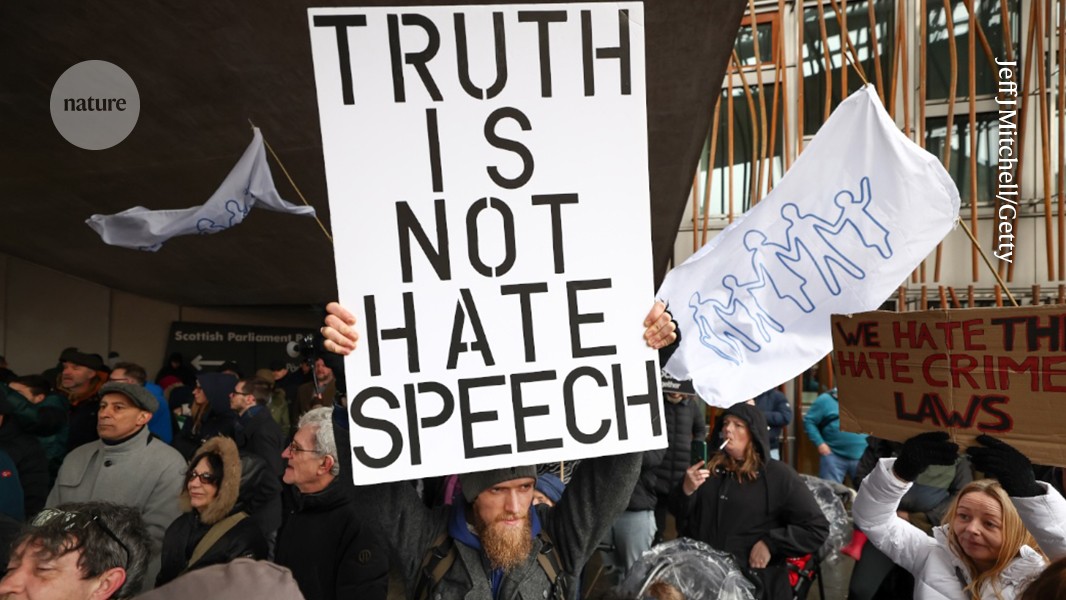
Hate speech — discourse that attacks a person or group on the basis of their inherent characteristics or identity — is on the rise worldwide. It can be triggered by various events, from elections to migrant crises to this year’s men's football World Cup. Posts hostile to people of South Asian origin in the US rose by 240% on the social media platform X between January 2024 and June 2026.
Hateful discourse can widen social divisions, instill ‘us versus them’ narratives, increase political polarization. Divisive rhetoric is also being exacerbated by content generated by artificial-intelligence models and bot accounts. Scientists are keen to understand these phenomena so that they can find the most effective ways to counter them.
Mirta Galesic, a co-leader of the research group Collective Minds at the Complexity Science Hub in Vienna, studies hate speech and anti-hate speech, called counterspeech. Galesic talks to Nature about strategies to tackle hateful discourse online. In some countries, polarization is quite prominent — especially ‘affective polarization’, when individuals dislike people who have different political opinions to their own.
Rising inequality, shifts in power, armed conflicts and institutions not working as well as they were before create uncertainty. The accumulation of this uncertainty is easily channelled into hate towards particular groups of people. And given how easy it is to lead people into thinking the worst about others — especially now, by using AI tools to create fake photos and videos — I would say that it’s extremely important to study hate speech.
Everyone should be able to recognize their own susceptibility to be manipulated. My colleagues and I analysed more than one million posts made between January 2015 and December 2018 on the social-media site Twitter (now known as X). These posts were responses to roughly 130,000 posts by German news organizations, journalists, bloggers and politicians.
This time period started with what is sometimes referred to as the ‘migrant crisis’ in Germany, when more than one million refugees and asylum seekers moved there after a policy change allowed them to apply to stay in the nation from Germany, rather than from the first European Union country they arrived in. In subsequent studies, we used large language models to measure hate in conversations. We also categorized numerous ways in which posters responded to each other and identified which strategies were most effective at countering hate.
Extract — continue reading at the source.


