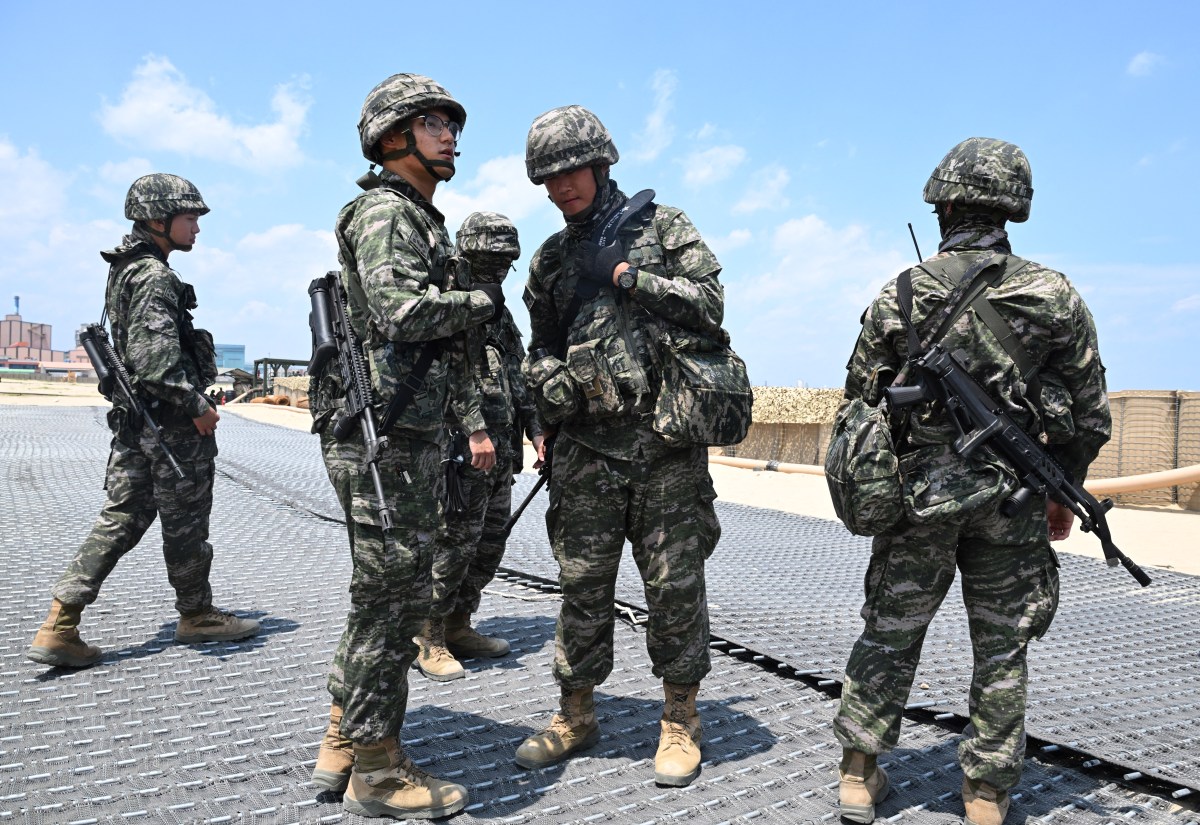
Donald Trump's decision to scale back military drills with South Korea could open the door to renewed talks with North Korea, potentially offering Washington a chance to negotiate limits on Pyongyang’s growing nuclear arsenal, analysts say. The U.S. president said on Sunday he had instructed his Defense Secretary Pete Hegseth to reduce annual U.S.-South Korea military exercises, citing his good ties with North Korean leader Kim Jong Un and Seoul’s lack of assistance with the war in Iran. The latest exercises began Monday as planned.
During his first term in office, Trump met with Kim three times for denuclearization talks that were unsuccessful. Since then, Pyongyang has expanded its nuclear arsenal, assembling around 60 assembled and having enough fissile material to produce at least 30 more, according to a June 2026 report from the Stockholm-based think tank. This month, Pyongyang conducted ballistic missile tests banned by the United Nations.
Trump's announcement on Truth Social sparked alarm from Democrats, Republicans and South Korea, that such a move might embolden Pyongyang and cast doubt on Washington's reliability as an ally at a testing geopolitical time. But Evan Sankey, a policy analyst at the Cato Institute think tank said the order has raised the question of whether a new push for U.S.-North Korea talks could follow. "There is little prospect of convincing Kim to give up his nuclear weapons, but talks could lead to caps on his missile arsenal and stockpile of fissile material," he told Newsweek.
Jennifer Kavanagh, director of military analysis at Defense Priorities, a think tank, described Trump's announcement as “both a necessary and strategically wise one aligned with U.S. interests.” Newsweek has contacted the White House and the South Korean foreign ministry for comment. South Korea hosts the largest overseas American military installation, Camp Humphreys, and the countries hold regular joint military drills. The annual exercises called Ulchi Freedom Shield started on Monday as planned and reported they would focus on dealing with North Korea’s evolving capabilities with training to counter drones, GPS disruption and cyberattacks.
At least 18,000 South Korean troops were also taking part, according to local authorities. However, North Korea has long criticized such exercises, last week calling the planned drills “a rehearsal for an aggressive war.”Trump posted on Truth Social that the drills send a message that is "hostile" to North Korea which has been "unthreatening and respectful,” in comments that prompted a strong reaction. Jack Reed, the top Democrat on the Senate Armed Services Committee, said Trump was "cutting military exercises to flatter a dictator." Republican Sen.
Thom Tillis said Trump's announcement to reduce the drills "does nothing more than free up thousands of North Korea's troops" to support Russia's war effort. Meanwhile, the South Korean newspaper Hankook Ilbo said in an op-ed Trump's announcement "reveals the stark reality of a faltering Korea-U.S. alliance." Sankey from CATO said that Trump's announcement was reminiscent of his cancellation of exercises during his rounds of negotiations with Kim in 2018 and 2019. "Today there are no known U.S.-DPRK talks, but scaling back exercises could presage a U.S. overture," Sankey said, "that would be welcome because U.S. policy toward the DPRK is at a dead end." Kavanagh, from Defense Priorities, said in a statement to Newsweek that there is little evidence drills with South Korea deter aggression by North Korea and China and help with regional stability, “in fact, they seem to work in the other direction.” “Far from being deterred, China and North Korea often respond by accelerating their military buildups and expanding their regional military activities, including with their own military exercises or test launches of new weapons,” Kavanagh added.
Extract — continue reading at the source.