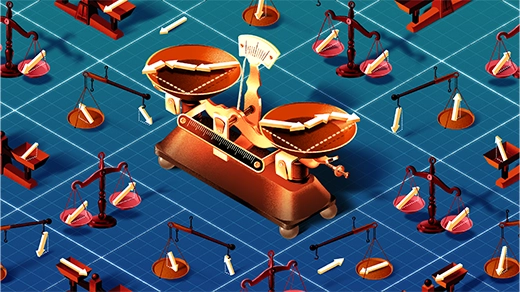
One does not need a doctorate in mathematics to split 12 eager trivia buffs into two competitive teams. But consider that each person arrives with unique strengths and liabilities: One may be a geography obsessive with no ear for music, another could be a naturalist who doesn’t own a television, and another could be a cinephile who never reads. Balancing traits between two camps becomes a lot harder.
So, how evenly can you assemble the teams so that they have matching firepower in every category, from Greek mythology to college basketball? You can always make the teams surprisingly even, according to researchers studying combinatorial discrepancy theory. Discrepancy theory is a branch of mathematics concerned with allocating resources as evenly as possible.
If one trivia team gets all the history knowledge, leaving none for the other, that’s a big discrepancy. In the early 1980s, the mathematician János Komlós came up with a counterintuitive prediction. He conjectured that no matter how many objects (your players) or dimensions (trivia categories) you consider, the discrepancy — which you can quantify — will never exceed a constant amount.
There will always be a way to divide the teams with a discrepancy below that exact amount. It’s a universal constant.” No one has ever found a way to contradict the conjecture. Yet it is so astonishing that some mathematicians thought it must be false.
Proving it is “one of these holy-grail problems in discrepancy theory,” said Nikhil Bansal, a theoretical computer scientist from the University of Michigan. Even the conjecture’s creator thinks it’s somewhat absurd. But for decades, a proof looked like a long shot.
Mathematicians weren’t able to make much progress; their best upper limit on the discrepancy, achieved in 1998, still depended strongly on the dimension of the problem. It was far from constant. Then, in fall 2025, Bansal and Jiang announced the first major advance on the problem in nearly 30 years.
Extract — continue reading at the source.