We have become quite used to pronouncements of doom, from scientists predicting the sixth mass extinction due to the measurable effects of climate change, and from religionists declaring the apocalypse due to a surfeit of sin. It’s almost impossible to imagine these two groups of people agreeing on anything other than the ominous portent of their respective messages. But in the early days of the scientific revolution—the days of Shakespeare’s contemporary Francis Bacon, and later 17th century Descartes—it was not at all unusual to find both kinds of reasoning, or unreasoning, in the same person, along with beliefs in magic, divination, astrology, etc.
Yet even in this maelstrom of heterodox thought and practices, Sir Isaac Newton stood out as a particularly odd co-existence of esoteric biblical prophecy, occult beliefs, and a rigid, formal mathematics that not only adhered to the inductive scientific method, but also expanded its potential by applying general axioms to specific cases. Yet many of Newton’s general principles would seem totally inimical to the naturalism of most physicists today. As he was formulating the principles of gravity and three laws of motion, for example, Newton also sought the legendary Philosopher’s Stone and attempted to turn metal to gold.
Moreover, the devoutly religious Newton wrote theological treatises interpreting Biblical prophecies and predicting the end of the world. The date he arrived at? 2060. Newton seems, writes science blog Another Pale Blue Dot, “as confident of his predictions in this realm as he was in the rational world of science.” In a 1704 letter exhibited at Jerusalem’s Hebrew University, above, Newton describes his “recconing”: So then the time times & half a time are 42 months or 1260 days or three years & an half, recconing twelve months to a yeare & 30 days to a month as was done in the Calendar of the primitive year.
And the days of short lived Beasts being put for the years of lived [sic] kingdoms, the period of 1260 days, if dated from the complete conquest of the three kings A.C. 800, will end A.C. 2060. It may end later, but I see no reason for its ending sooner. Newton further demonstrates his confidence in the next sentence, writing that his intent, “though not to assert” an answer, should in any event “put a stop the rash conjectures of fancifull men who are frequently predicting the time of the end.” Indeed.
So how did he arrive at this number? Newton applied a rigorous method, that is to be sure. If you have the patience for an exhaustive description of how he worked out his prediction using the Book of Daniel, you may read one here by historian of science Stephen Snobelen, who also points out how widespread the interest in Newton’s odd beliefs has become, reaching across every continent, though scholars have known about this side of the Enlightenment giant for a long time.
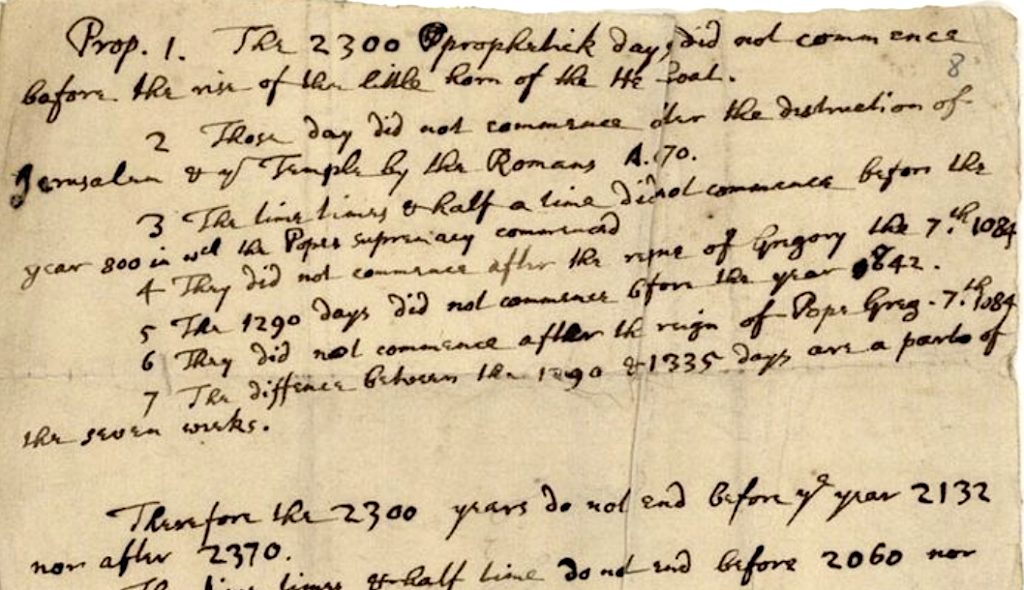
For a sense of the exacting, yet completely bizarre flavor of Newton’s prophetic calculations, see another Newton letter at the top of the post, transcribed below. The 2300 prophetick days did not commence before the rise of the little horn of the He Goat. 2 Those day [sic] did not commence a[f]ter the destruction of Jerusalem & ye Temple by the Romans A.[D.] 70. 3 The time times & half a time did not commence before the year 800 in wch the Popes supremacy commenced 4 They did not commence after the re[ig]ne of Gregory the 7th. 1084 5 The 1290 days did not commence b[e]fore the year 842. 6 They did not commence after the reigne of Pope Greg. 7th. 1084 7 The diffence [sic] between the 1290 & 1335 days are a parts of the seven weeks. Therefore the 2300 years do not end before ye year 2132 nor after 2370.
Extract — continue reading at the source.