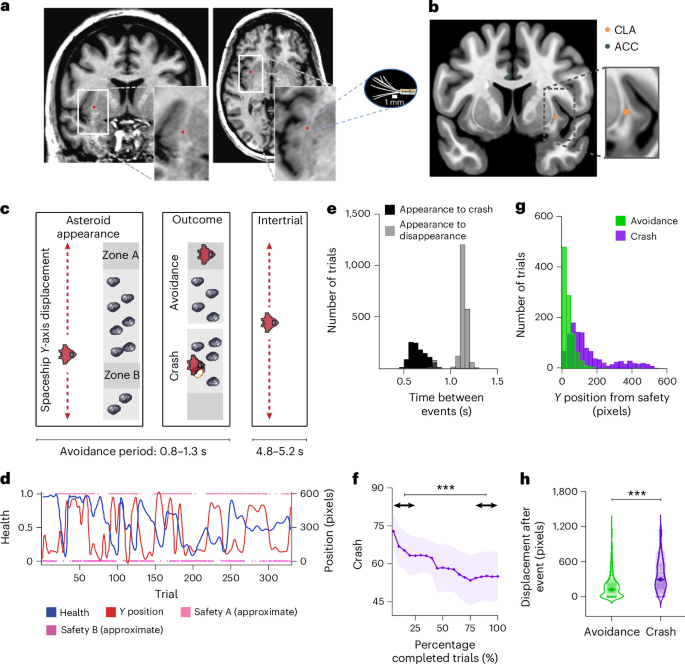
Flexible behavior depends on continuous updating of internal models, yet the neural circuits coordinating this process remain poorly understood. The claustrum, which is reciprocally connected to nearly the entire neocortex, is uniquely positioned to influence cortical processing. Here we report single-neuron recordings from the human claustrum during aversive learning, with anterior cingulate cortex and amygdala recordings for comparison.
Claustrum and anterior cingulate neurons displayed structured, task-related responses. Distinct subpopulations encoded stimulus onset and action-contingent outcomes, with outcome representations diverging between regions. Critically, both regions encoded model-derived latent variables, including uncertainty and prediction error, but with different temporal profiles; only the anterior cingulate carried uncertainty signals during the intertrial period, whereas both regions encoded uncertainty and prediction error during the active-avoidance period.
By contrast, the amygdala showed minimal latent-variable modulation. These findings provide evidence that human claustrum neurons track higher-order cognitive variables not directly observable from sensory input and reveal dissociable roles for the claustrum and anterior cingulate cortex in tracking latent task states. The human brain’s ability to learn and adapt in ever-changing environments emerges from its hierarchical organization and the evolved interplay of distributed neural systems.
The claustrum (CLA), a thin sheetlike structure buried deep within subcortical white matter1, maintains widespread cortical and subcortical connections2,3, yet its functional role remains poorly understood. Theoretical accounts of CLA function range from assigning it a central role in conscious integration to dismissing it as an evolutionary vestige4,5. What has been lacking, particularly in humans, is direct neural evidence linking CLA activity to higher-level cognition.
Anatomical tracing in mice and nonhuman primates demonstrates that the CLA is densely interconnected with frontal cortical regions1,2,3,4,6. Notably, cortical areas that communicate via direct cortico-cortical pathways also receive convergent input from bifurcating CLA neurons1, suggesting that the CLA is positioned to coordinate distributed cortical activity according to contextual and situational demands. Consistent with this circuit architecture, the anterior cingulate cortex (ACC)—a region implicated in higher-order processes, including cognitive control7 and salience processing in humans8—has been shown to exert top-down influence on rodent claustral activity during anticipation and task engagement9,10.
Reciprocally, ACC signals can be transiently amplified through CLA projections to parietal association and visual cortices11, and large-scale recordings further indicate that CLA modulates cortical dynamics in a structured, layer-specific manner11,12. Optogenetic stimulation in rodents has also shown that CLA preferentially propagates top-down signals rather than bottom-up signals10. In contrast, single-unit recordings from nonhuman primates13 suggest that CLA representations are predominantly unimodal, spatially segregated and lack audiovisual integration—features consistent with the traditional view of the CLA as a passive sensory relay.
Extract — continue reading at the source.


