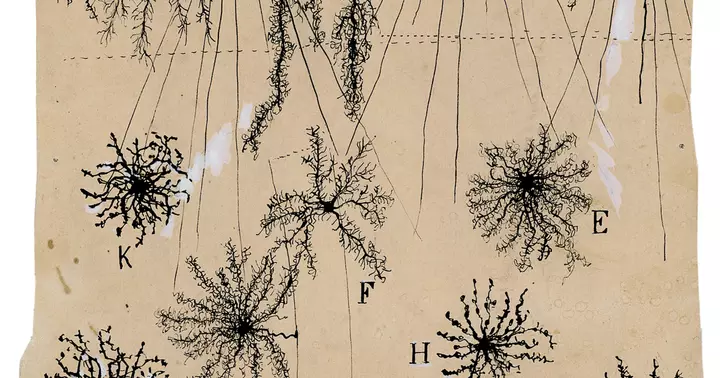
Meanwhile, ninety miles inland from William James, while Walt Whitman was redoubling his metaphysical insistence that “the body includes and is the meaning, the main concern… and is the soul,” Emily Dickinson was writing in one of her science-prescient poems: The Brain — is wider than the Sky — For — put them side by side — The one the other will contain With ease — and you — beside — The Brain is deeper than the sea — For — hold them — Blue to Blue — The one the other will absorb — As sponges — Buckets — do — It is the task, the destiny of science to concretize with evidence what the poets have always intuited and imagized in abstraction: that we are infinitely more miraculous and infinitely less important than we thought. The universe without, which made us and every star-dusted atom of our consciousness, is ever-vaster and more complex than we suppose it to be; the universe within, which makes the universe without and renders our entire experience of reality through the telescopic lens of our consciousness, is ever-denser and more complex than we suppose it to be. A century and a half after James, neuroscientist Antonio Damasio picks up an empirical baton where Dickinson had left a torch of intuition.
In his revelatory book Feeling & Knowing: Making Minds Conscious (public library), he makes the bold case that consciousness — that ultimate lens of being, which shapes our entire experience of life and makes blue appear blue and gives poems their air of wonder — is not a mental activity confined to the brain but a complex embodied phenomenon governed by the nervous-system activity we call feeling. Decades after Toni Morrison celebrated the body as the supreme instrument of sanity and self-regard, neuroscience affirms the body as the instrument of feeling that makes the symphony of consciousness possible: feelings, which arise from the dialogue between the body and the nervous system, are not a byproduct of consciousness but made consciousness emerge. (Twenty years earlier — an epoch in the hitherto lifespan of neuroscience — the uncommonly penetrating Martha Nussbaum had anticipated this physiological reality through the lens of philosophy, writing in her superb inquiry into the intelligence of emotions that “emotions are not just the fuel that powers the psychological mechanism of a reasoning creature, they are parts, highly complex and messy parts, of this creature’s reasoning itself.”) Damasio’s premise rises from the flatland of earlier mind-based theories by a conceptual fulcrum both simple and profound: Feelings gave birth to consciousness and gifted it generously to the rest of the mind. This view defies both extremes that dominate our present models of consciousness, each unimaginative and intellectually unambitious in its own way, as all extremes invariably are: materialism, which confines it to the neural activity of the brain, and mysticism, which places it entirely outside the contours of the body and beyond the reach of scientific investigation.
Damasio writes: Any theory that bypasses the nervous system in order to account for the existence of minds and consciousness is destined to failure. The nervous system is the critical contributor to the realization of minds, consciousness, and the creative reasoning that they allow. But any theory that relies exclusively on the nervous system to account for minds and consciousness is also bound to fail.
Unfortunately, that is the case with most theories today. The hopeless attempts to explain consciousness exclusively in terms of nervous activity are partly responsible for the idea that consciousness is an inexplicable mystery. While it is true that consciousness, as we know it, only fully emerges in organisms endowed with nervous systems, it is also true that consciousness requires abundant interactions between the central part of those systems — the brain proper — and varied non-nervous parts of the body.
Drawing on the native poetics of our physiology, Damasio offers a definition of consciousness: Consciousness… is a particular state of mind resulting from a biological process toward which multiple mental events make a contribution… These contributions converge, in a regimented way, to produce something quite complex and yet perfectly natural: the encompassing mental experience of a living organism caught, moment after moment, in the act of apprehending the world within itself and, wonder of wonders, the world around itself. A century and a half after Darwin scribbled a note to himself in the margin of one of his manuscripts — “Never say higher or lower in referring to organisms… Say more complicated.” — Damasio details the levels of complexity by which various organisms manage the living wonder of themselves. All life-forms, from bacteria to Bach, share a basic machinery of stimulus-detection called sensing.
Organisms with nervous systems are capable of minding — the neurobiological process of mapping information into patterns and translating it into mental images. These images furnish representations of the world, making it comprehensible and therefore survivable as the organism navigates that world by a sort of native biological intelligence that powers the basic self-care necessary for maintaining homeostasis — maintenance that eventually comes aglow with feeling. More complex organisms can manipulate those images, integrating them into a system of reference we call knowledge, which the nervous system makes explicit by creating patterns and committing them to memory, so that the organism can plan, reason, and reflect.
Extract — continue reading at the source.