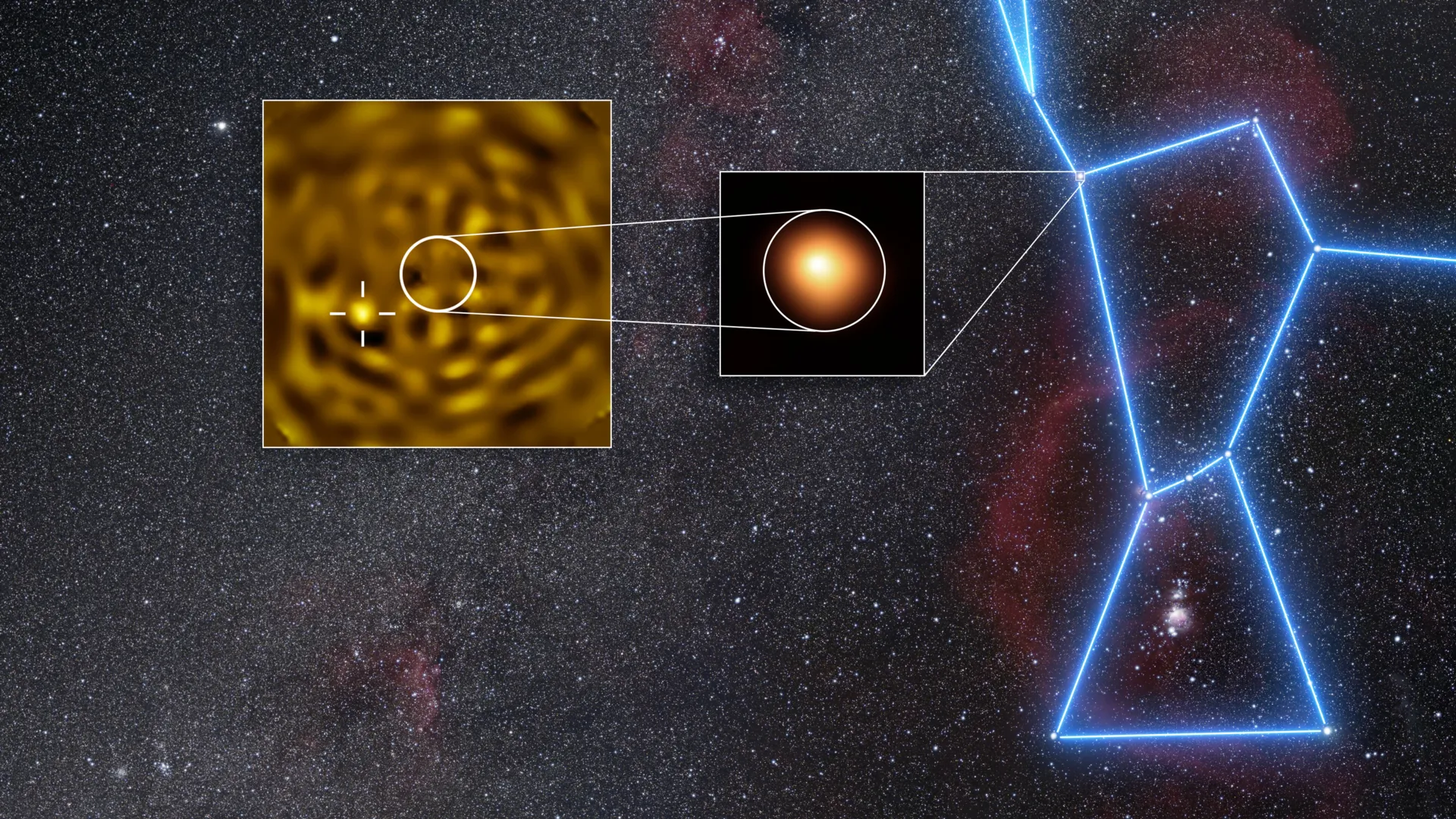
Astronomers now have their strongest evidence yet that Betelgeuse, one of the best-known stars in the night sky, has a stellar companion. A team led by French astronomer Miguel Montargès used the European Southern Observatory's Very Large Telescope (ESO's VLT) to capture the clearest image so far of what is believed to be Betelgeuse B, a star orbiting the famous red supergiant. "This is the conclusion of a century-long quest," says Montargès.
"We have shown that Betelgeuse is not single, it is accompanied by a faint stellar companion," says Montargès, astronomer at the Observatoire de Paris -- PSL, France, and lead author of the study published today in Astronomy & Astrophysics. Betelgeuse -- a reddish star in the Orion constellation that is easily visible with the naked eye and is known to change in brightness -- has been watched by people for thousands of years. Even after centuries of scientific observation, however, the star continues to produce surprises.
"I jumped from my chair when I saw the processed images," recalls Montargès. The possibility that Betelgeuse has a companion was first raised roughly a century ago as a potential explanation for some of its changes in brightness. Despite decades of observations, astronomers had been unable to clearly detect such a star.
That changed after Two studies published in 2024 made strong predictions about where the suspected companion should be. The studies indicated that Betelgeuse B would reach its greatest apparent separation from Betelgeuse in December 2024, giving astronomers their best opportunity to see it. Montargès and his colleagues observed Betelgeuse with ESO's VLT that December.
They then spent several months carefully processing and analyzing the observations. "Honestly, I thought we did not have the sensitivity to detect Betelgeuse B as it was predicted," explains Montargès. "Because it is more massive than predicted, we see it!" Scientists had initially estimated that the companion would have roughly the same mass as the Sun.
The new observations instead suggest that Betelgeuse B is considerably larger, with about two to three times the Sun's mass. "The fact that we can still discover a nearby companion, more massive and brighter than the Sun, around such a well-studied star is remarkable," says Montargès. "These are among the best moments in science: seeing something new, unexpected." The Clearest Image Yet of Betelgeuse's Companion The researchers directly imaged Betelgeuse B, meaning they detected light coming from the companion itself.
Extract — continue reading at the source.


