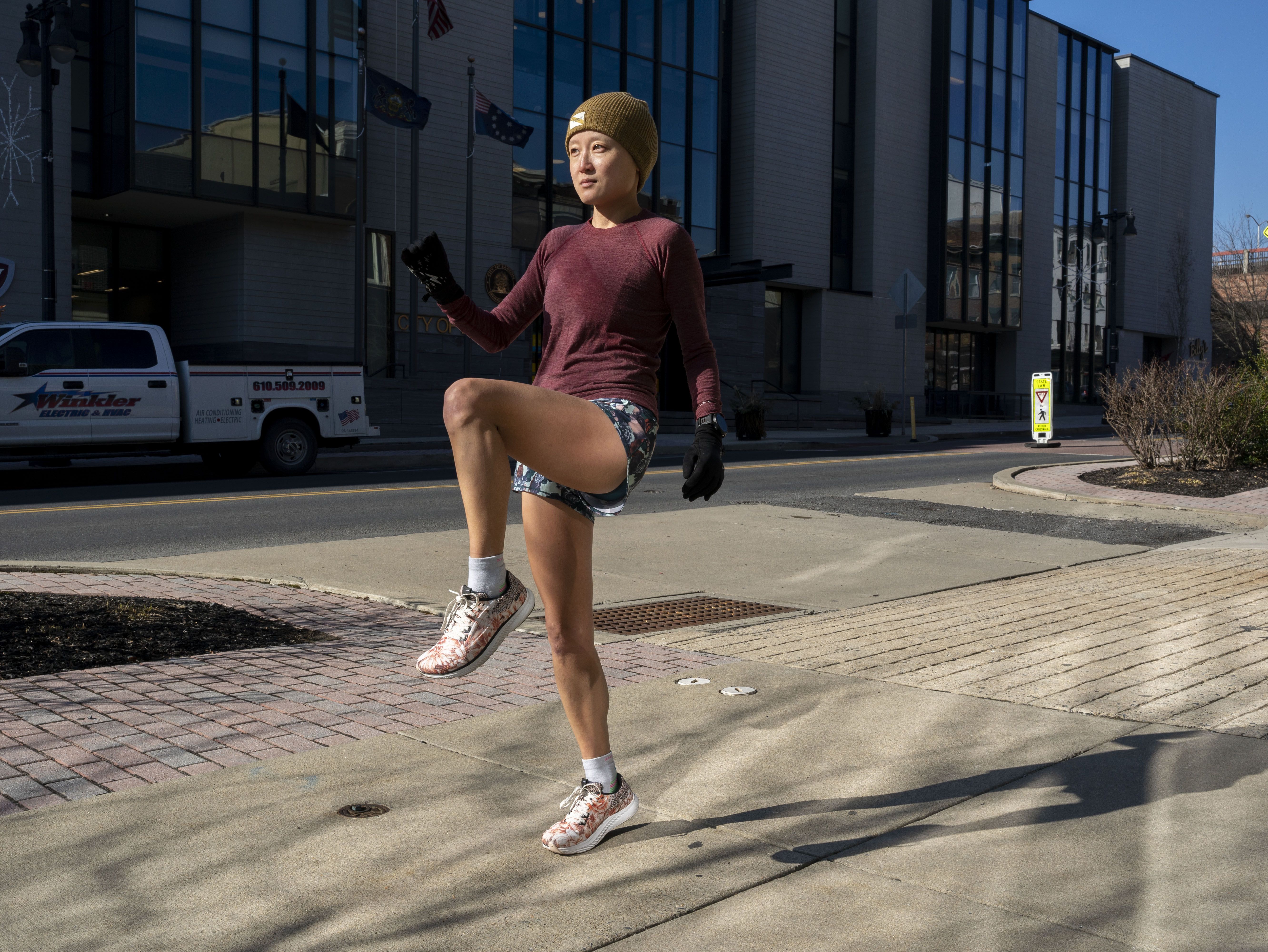
Most physical therapists and sports medicine doctors use the analogy of a train jumping its track to describe what causes runner’s knee pain. Typically, the cause of classic runner’s knee is poor mechanics and form issues, which is a way of saying the cause of the pain is forcing the “train” off its intended “track.” Research shows, however, that sometimes there are other reasons for that annoying knee pain. In fact, if you’re a woman or if you have flat feet, you will be more likely to develop runner’s knee.
I’m both, and yes, I had—and solved—knee pain. Runners can do as I did and respond to both of these situations so that knee pain does not limit their running, and the solutions are not that complicated or time-consuming if you know what to do. However, they are nonnegotiable because even if you don’t currently have knee pain, you’ll want to protect yourself against it in the future.
In my own case, exercise and different running shoes made all the difference, and I now run without ever worrying about my knees. 🏃🏻♀️ Recognize symptoms, recover safely, and build strength to prevent setbacks with the Runner’s World Guide to Common Running Injuries. It has long been known that because women have wider hips in relation to the width of their knees, i.e., the angle (called “Q”) from the hip to the knee, that they are more prone to knee pain. However, the researchers who wrote a 2018 article in Orthopedic Reviews found that females with patellofemoral pain syndrome, i.e., runner’s knee, “demonstrate a decrease in abduction, external rotation and extension strength of the affected side compared with healthy patients.” In other words, it’s not the angle itself that causes the problem, but the lack of flexibility, strength, and mobility, specifically, between their “vastus medialis” (inner front thigh) and lateralis (outer thigh).
This may develop because having wider-set hips affects the angle at which these muscles support (or don’t support) the knee. Women are also more prone to issues with their ligaments, which are the flexible bands of tissue that connect bones to one another. Estrogen, the primary female hormone, can make a woman’s ligaments more flexible, which decreases the level of strength and stability to your knees, especially since you are already being affected by the “Q” angle.
Strengthening all of the thigh muscles and stretching the iliotibial (IT) band, a tendon that attaches from the hip to the outer side of the knee. When tight, it can become inflamed and painful, which sometimes shows up as knee pain. I’m a big fan of the curve of my hips, and so wouldn’t trade my Q angle for knees that are built for running.
However, I did become a regular “knee exercises” fan, especially to strengthen my quads and inner and outer thighs. I absolutely think these moves are the ones that have helped me over the last couple of years. Just don’t stop doing them once the pain is gone!
Extract — continue reading at the source.


