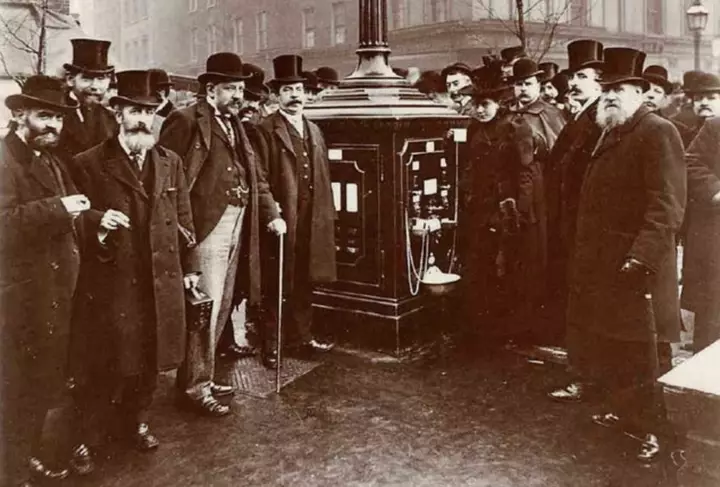
Any reader of Victorian literature will wonder how much a ha’penny was actually worth in those days. For a little more than a year at the very end of that period, it could buy you a cup of coffee, cocoa, milk, tea, or “fluid beef” — which would pour out of a lamppost on the corner. The Pluto Lamp, as it was branded, made its debut at the Victorian Era Exhibition, which was held in 1897 to celebrate the Queen’s Diamond Jubilee.
Amid such attractions as a 360-degree panorama of ancient Rome, Pepper’s ghost illusions, and over 1,200 works of art by the likes of J. Turner, John Constable, and 180 specially selected female artists, a beverage-dispensing streetlight might seem mundane. Yet apart from being a technological marvel in its own way, it also presaged the technology-saturated streets one day to come.
Not long after the Victorian Era Exhibition, Pluto Lamps appeared in several London locations, including Exmouth Street in Clerkenwell, Leicester Square, and Rosebery Avenue. In addition to the illumination of their surroundings, and the drinks warmed by the excess heat thus generated, they in some cases offered postcards and four-to-the-penny cigarettes for sale as well. However much attention the Pluto Lamps attracted as a novelty, this was still the infancy of the modern vending machine, whose deficiencies had yet to be fully worked out.
It proved impossible, at the time, to defeat the enterprising scoundrels who used round pieces of tin in place of genuine currency, and in any case, maintenance costs seem to have proven unexpectedly high. (To say nothing of the prospect of drinking out of an enamel cup on a chain, shared with the entire public, which surely put off even some Victorians.) All of the Pluto Lamps were decommissioned before the end of the nineteenth century, but they’d done their bit to expand public ideas of what was possible in the urban public realm. City infrastructure and street furniture would once again become multi-purpose, multi-use, entrepreneurial, and connected.” And indeed, though talk of “smart cities” may now sound as dated and unappealing as that of fluid beef, lampposts have more recently been given such side jobs as vehicle charging, environmental protection, and even crime prevention. That last brings back to mind the Clerkenwell Pluto Lamp, equipped as it was with a telegraph recorder connected straight to Scotland Yard: a device that, had it lasted longer, might have inspired many a Victorian novelist.
Slot Machine Age: A 1964 British Newsreel Angsts Over Whether Automated Machines Will Displace People Behold the Art-o-Mat: Vintage Cigarette Vending Machines Get Repurposed & Dispense Works of Art Jim Power, aka “the Mosaic Man,” Adorns the Lampposts of New York City’s East Village French Vending Machines Fill Your Mind with Nourishing Short Stories, Not Your Body with Junk Food Inside the Automats Where Coin-Operated Machines Created a Modern, Democratic Dining Experience Watch the “Biblio-Mat” Book-Vending Machine Dispense Literary Delight Based in Seoul, Colin Marshall writes and broadcasts on cities, language, and culture. He’s the author of the newsletter Books on Cities as well as the books 한국 요약 금지 (No Summarizing Korea) and Korean Newtro. Follow him on the social network formerly known as Twitter at @colinmarshall. by Colin Marshall | Permalink | Comments (0) | We’re hoping to rely on our loyal readers rather than erratic ads.
To support Open Culture’s educational mission, please consider making a donation. We accept PayPal, Venmo (@openculture), Patreon and Crypto! Please find all options here.
Extract — continue reading at the source.