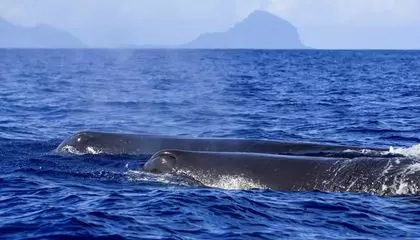
Viral videos in recent years reveal how it occurs: As the paddlers move along the water, a whale rises above the surface with its huge mouth open and takes in the people and the vessel. Shortly afterward, the whale lets them go. That’s what happened to Adrián Simancas in 2025 when he was kayaking in Chile’s Strait of Magellan.
This incident reportedly inspired author Daniel Kraus’ 2023 novel, Whalefall. The novel’s movie adaptation, directed by Brian Duffield and starring Austin Abrams and Josh Brolin, is in theaters now. In the 1940 Disney animated film, Geppetto, Pinocchio and their sidekicks get caught in the mouth of a sperm whale named Monstro, who eventually sneezes them out.
The book revolves around Jay Gardiner, a teenager living on the California coast. Jay is dealing with the death of his father, with whom he had a complicated relationship. Mitt eventually throws himself off a boat, knowing that otherwise he will soon die from the cancer.
Later, Jay goes diving in the area where his dad died and tries to find his remains as a way “to make peace with the rest of his family,” Kraus says. While submerged, Jay is swallowed by a sperm whale. He then must fight to survive and escape the giant creature’s stomach.
So what happens is really the only thing that could happen, which is that Jay gets entangled with a giant squid,” says Kraus. So he’s essentially pulled into the stomach with the squid.” Kraus worked with a team of scientists to represent whale anatomy as accurately as possible. One of the most important pieces of information he learned was that most whales can’t swallow a human due to the size of their throats.
Nick Pyenson, curator of fossil marine mammals at the Smithsonian’s National Museum of Natural History, explains that there are two main categories of whales: baleen and toothed. The humpback is one of the former, using baleen plates to sieve prey—typically small fish and crustaceans—from the water. The sperm whale is the largest of the toothed cetaceans and consumes giant squid, its main prey.
Extract — continue reading at the source.
/https://tf-cmsv2-smithsonianmag-media.s3.amazonaws.com/filer_public/aa/63/aa632d4b-490b-4f4b-9ba3-f0219d6e2598/jackie-main.png)