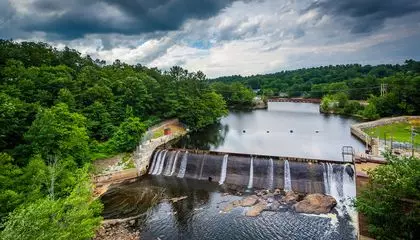
In 1859, a committee of farmers in Billerica, Massachusetts, having grown irked by a dam on the Concord River, hired a surveyor to justify its destruction. The dam, which powered a textile factory owned by an industrialist named Charles Talbot, was allegedly flooding their fields and spoiling their hay; now they wanted the wall and its reservoir gone. They hoped the surveyor’s evidence would persuade a court to order its obliteration.
The surveyor—a conscientious, lushly bearded man of good repute—set about plumbing the Concord’s bottom, measuring its bridges and scrutinizing high-water marks. In truth, he didn’t love the work, describing surveying as “drudgery” in his journals. Henry David Thoreau’s truest passion, of course, wasn’t surveying land, but writing about it.
Aside from the paycheck, the now-legendary author had another motivation to take the Concord job: He despised the Talbot Mills Dam. A decade earlier, Thoreau had published the travelogue A Week on the Concord and Merrimack Rivers, in which he inveighed against the dam for blocking the passage of spawning fish, especially American shad. Where is thy redress?” Thoreau wrote.
Although Thoreau’s surveys supported the farmers’ case, on appeal, the state of Massachusetts permitted the dam to remain. This can’t have surprised Thoreau, who knew that dams made for intractable opponents. For many fish-blocking dams, however, it hasn’t taken “a few thousands of years” to level them after all.
Since 1912, more than 2,300 dams have been purged from waterways in the United States, most in the last quarter-century. The dam-removal movement hit its apogee in 2024, when, by the accounting of the nonprofit American Rivers, dam removals reconnected more than 2,500 miles of once-fragmented waterways. The year’s biggest and best-publicized dam obliteration occurred on the Klamath River, where the dismantling of four aging hydroelectric dams opened more than 400 miles of spawning habitat in California and Oregon to chinook salmon, which recolonized the watershed so rapidly that conservationists described the comeback as “magical.” Before the Klamath, the nation’s largest undamming took place on Washington State’s Elwha River, where two fish-blocking walls were obliterated on behalf of chinook, coho, steelhead and other salmonids.
Yet it would be a mistake to presume that dam removals primarily benefit western salmon rivers. Though they’re typically smaller in scale and receive less fanfare, the majority occur in eastern states. In 2024, the Blake Higgins Dam came tumbling down in Vermont, the Edes Falls Dam departed the Crooked River in Maine, and the Kimball Brook Dam vanished from New Hampshire.
Extract — continue reading at the source.