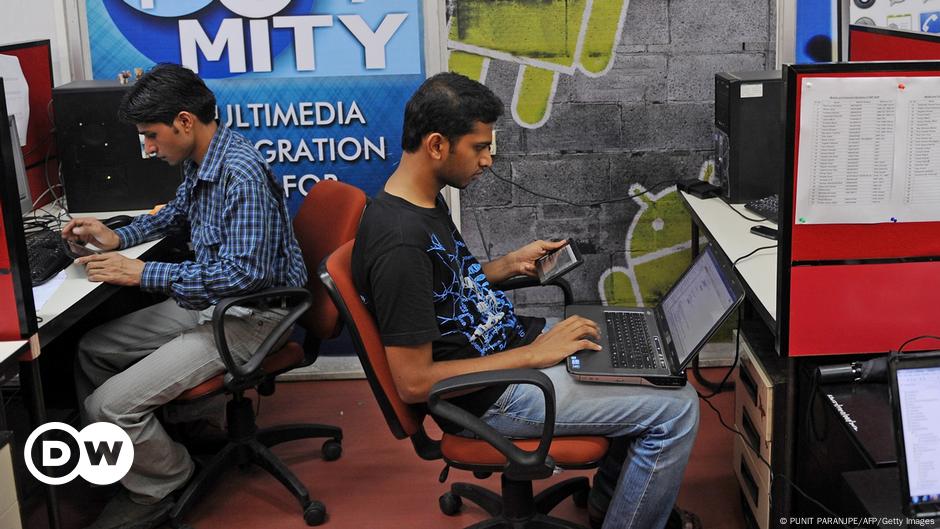
Across India, young workers are increasingly turning to artificial intelligence (AI) to speed up routine tasks, whether researching news stories, translating copy, analyzing business data or sorting legal documents. But the technology can get things wrong, and relying on it too heavily carries risks. Journalist Farah Kazmi, 28, who works for a news portal in New Delhi, used AI while reporting on rules governing stray animals and feeding them in gated communities.
She asked an AI model to find the Supreme Court's latest guidelines, earlier court rulings and recent dog-bite cases. "Since it can take quite a lot of time to search Google for specific articles about court rulings, previous judgments or recent dog-bite cases, I asked AI to find them for me," Kazmi told DW. It gave her a starting point for relevant articles and cases, which she then read and cross-checked herself.
To view this video please enable JavaScript, and consider upgrading to a web browser that supports HTML5 video She also uses AI to translate English copy into Hindi for the Hindi news team, and Hindi quotes into English. But translations need careful checking, Kazmi said, pointing out that in one case, AI interpreted the name "Suraj" as "sun," changing the sentence's meaning. "Before using AI, I mostly relied on Google Translate.
It was more literal and did not always understand the context. AI gives a much better and more context-based translation, although it still needs to be checked and corrected," she said. AI has not fundamentally changed journalism, which still involves talking to people and reporting from the field, Kazmi underlined.
"Ultimately, I see AI as a tool that helps with research and saves time, but the actual verification and reporting still has to be done by the journalist," she said. Yajatt Misra, 28, business strategy and international markets manager at Kanoria Chemicals and Industries, uses AI to analyze data, summarize large volumes of information, prepare first drafts and structure ideas. It also helps him turn financial and business information from different sources into management updates and presentations.
"Things like summarizing information, preparing first drafts, analyzing data and putting together presentations take less time now," Misra told DW. He said the challenge is knowing when to trust the output. AI can miss business context or get details wrong, so its numbers, logic and conclusions need checking.
Extract — continue reading at the source.