What do we mean when we say a filmmaker has returned to form? Danny Boyle has made Oscar-winning movies (Slumdog Millionaire), great movies that people will remember forever (Trainspotting, 28 Days Later), and superb, expressive movies that not many people think about anymore (Sunshine, A Life Less Ordinary). Boyle has been making movies for so long now—and has been making them in such varied textures—that it’s hard to say what form, exactly, there is for him to return to.
But Ink, which opens the Venice Film Festival, somehow feels both old-school—in the brash, Trainspotting way—and invigorating and modern; it’s almost as if Boyle were taking inspiration from himself, revisiting his catalog of ideas and revamping rather than repeating them. This is a bold, entertaining piece of filmmaking that also brings us back, perhaps to the precise year, when newspapers and other media organizations began veering away from serious news and toward the on-ramp of nonstop entertainment and stimulation. For that, we have news mogul Rupert Murdoch to thank.
But as Ink tells it, Murdoch learned how to be Murdoch from a lesser-known player you may never have heard of: who the hell was Larry Lamb? Ink, adapted from James Graham’s stage play and drawn from real life, opens in 1969 London on Fleet Street, the heart of the city’s newspaper business. The young, Australia-born Rupert Murdoch—played, with almost alarming charisma, by Guy Pearce—isn't yet a mover and shaker in the news business.
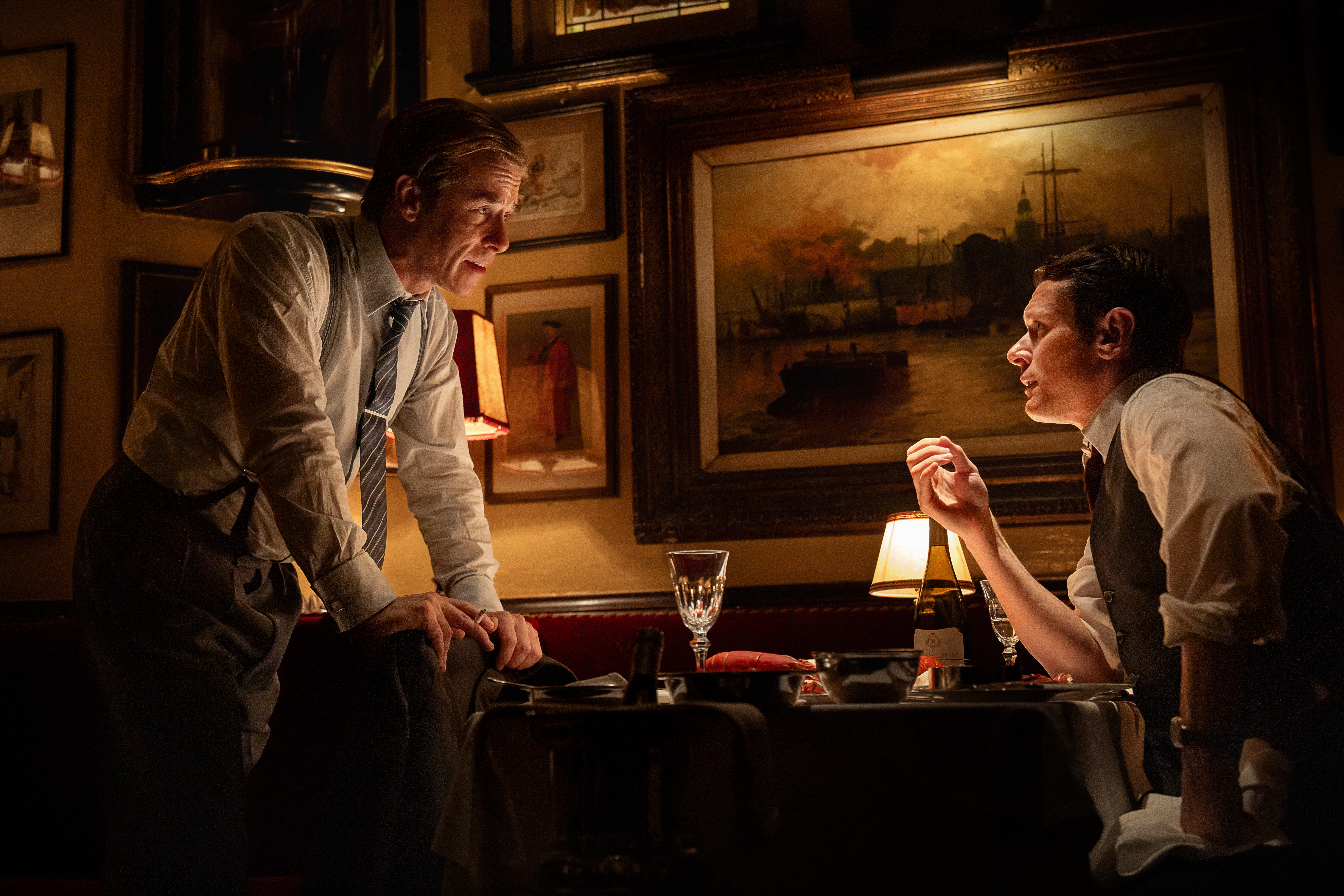
But he has a proposition for a brash Yorkshire newspaperman whose career has taken a nosedive. Would this guy, Larry Lamb—Jack O’Connell, crackling with roguish charm—like to spearhead the relaunch of a paper Murdoch has just purchased? The two meet in a tony London restaurant where newspaper deals are made, tussling like bulls as they outline their ideas of what news should be.
Then they stride out into the night, and as they pass the paper’s offices, they drop down on all fours to feel the rumble of the printing presses belowground. Newspapers are in their blood; they can’t differentiate between their own heartbeat and the clanking of tomorrow’s edition rolling off the cylinders. That image may sound corny, but as movie language, it works.
Boyle and cinematographer Alwin H. Küchler (who also shot Sunshine) give the movie a zig-zagging, simmering energy. If Trainspotting mapped the euphoria and careless self-destruction of heroin addicts, Ink is the story of another kind of obsessive: guys in thrall to the big story, to power, and to money, maybe not even necessarily in that order.
Extract — continue reading at the source.