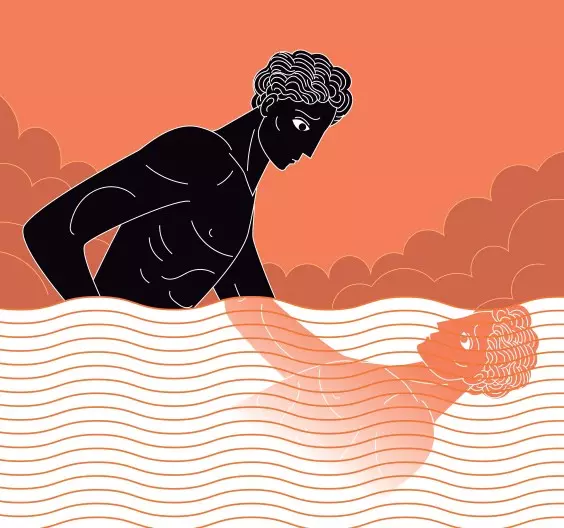
In recent years, the term “narcissist” has been swung around like a sword in the dark. In everyday use, it came to describe anyone guilty of routine selfishness. The word is lay shorthand for a clinical diagnosis, narcissistic personality disorder, defined by grandiosity, extreme need for admiration, and difficulty with empathy.
But milder versions of these traits, such as self-confidence and ambition, can be adaptive, and plenty of successful, well-functioning adults have employed them to get ahead. There is a lot we still don’t know about how people with narcissistic traits relate to others and to themselves. Or how these traits show up in the workings of the brain.
Recently, a team of scientists from Finland set out to get a better handle on what narcissism may look like in the brain during the kinds of socially complex interactions one might encounter in daily life. They called their work the “Faces of Narcissism” project. From an online survey of 1,000 people, the researchers chose 58 people to participate in brain scans.
This group included people who scored on the high ends and the low ends in confidence, entitlement, and attention seeking, traits associated with narcissism of the grandiose type. None of the individuals selected had been diagnosed with the clinical disorder. Studies of empathy often rely on simple tests of how a person responds to a picture of a sad face, or an image or video of someone in pain, for example a person responding to a needle prick.
But the human social world is much more tangled than that, so the scientists presented their subjects with videos of different social scenarios requiring some form of evaluation and interpretation from the viewer. While inside a scanner that traced the flow of blood through their brains, all of the subjects watched videos of an actor telling personal stories, recounting times they were admired or episodes where they were snubbed. Then someone gave the actor feedback that was meant to sting, suggesting either that the admiration was undeserved or that the rejection was the actor’s own fault.
The team found that the brains of people low in narcissistic traits moved in sync, with neural activity in areas related to interpreting social situations and to cognitive empathy following a similar pattern. The brains of those high in narcissistic traits were less in sync, suggesting they did not share the actor’s feelings of embarrassment. The scientists published their results in the journal Cerebral Cortex.
Extract — continue reading at the source.