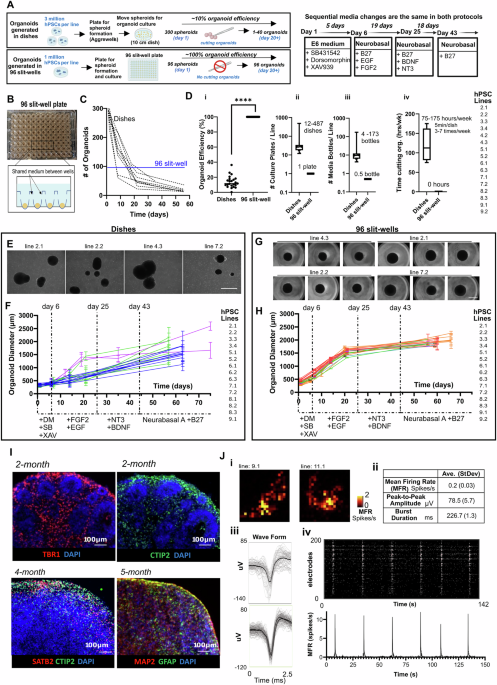
Human pluripotent stem cell (hPSC)-derived cortical organoids are powerful models but are often limited by low efficiency, variability, and stress-related artifacts. To address these challenges, we developed a scalable organoid platform with end-to-end quality control (QC) metrics spanning manufacturing and single-cell RNA-sequencing (scRNA-seq), developed using eight MAPT mutation isogenic line sets relevant to frontotemporal dementia (FTD-tau). Using a 96 slit-well format, we achieved ~100% organoid formation across 64 lines.
Controlled-release FGF2 enhanced hPSC pluripotency and reduced mesendodermal contaminants, while optimized SB431542 dosing enhanced cortical patterning across lines with variable TGFBR1/ALK5 expression. The resulting organoids displayed transcriptomic profiles and low-stress signatures closely aligned with the developing human cortex. Applying a cortical organoid scRNA-seq index (CortiCOSI), we identified early dysregulation of phosphatase regulators (PPP2CA, ANP32A) and the prefoldin subunit PFDN6 in MAPT V337M excitatory neurons before tau hyperphosphorylation and oligomerization.
This platform improves scalability, reproducibility, and mechanistic insight in cortical organoid studies. hPSC-derived brain organoids patterned toward the cerebral cortex are valuable models that capture the 3D multicellular interactions occurring in vivo in cortical tissue1,2,3,4,5,6,7,8,9,10. During cortical development, neural progenitor cells, including ventricular radial glia, outer radial glia, and intermediate progenitor cells, generate first deep-layer and then upper-layer cortical excitatory neurons, inhibitory neurons, astrocytes, and oligodendrocytes. hPSC-derived cortical organoids recapitulate this developmental sequence of in vivo cell production4,11,12,13,14,15,16,17. The resulting organoids can be cultured long-term, enabling temporal studies of cortical development and disease progression16,18,19,20,21. hPSC-derived cortical organoids can model various neurological and psychiatric conditions, including neurodevelopmental and neurodegenerative diseases20,22,23,24,25,26,27,28,29,30.
For example, we and others have used cortical organoids to study the pathological processes underlying dominantly inherited frontotemporal dementia (FTD) caused by mutations in MAPT, the gene encoding tau. FTD encompasses a clinical spectrum of behavioral, cognitive, language, and movement disorders. In individuals with MAPT mutations, the underlying neuropathology is characterized by frontotemporal lobular degeneration with tau pathology (FTLD-tau)18,19,30,31,32,33,34.
Over 50 disease-causing mutations in the MAPT gene have been identified35,36,37. We previously characterized the time course of changes due to the MAPT V337M mutation18. Early changes detected in 2-month organoids include altered expression of the RNA-binding protein ELAVL4, disrupted alternative splicing, premature development, disruption of glutamatergic pathways, and altered proteostasis18.
Later-stage organoids exhibited accumulated abnormally phosphorylated tau and selective glutamatergic cortical neuron death, which occurred predominantly at six months18. Thus, cortical organoids can recapitulate key temporal features of FTLD-tau pathogenesis and enable identification of novel genes and pathways. This prompted us to expand our analysis to additional MAPT mutation lines from the Tau Consortium collection38 to identify FTLD-associated pathophysiological phenotypes.
Extract — continue reading at the source.