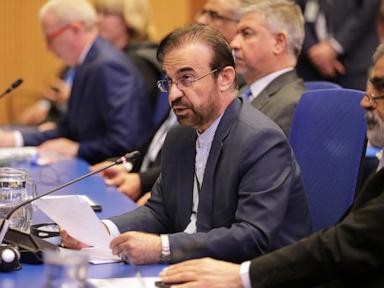
Iran has condemned the exclusion of its Atomic Energy Organization head from the UN nuclear agency's meeting in Vienna VIENNA -- Iran on Monday condemned the exclusion of the head of its Atomic Energy Organization from the annual gathering of the United Nations nuclear agency in Vienna saying that it constitutes “a serious breach” of Tehran's rights as a member nation. Najafi criticized Austria, the host country of the IAEA and other U.N. organizations, saying that Vienna’s decision not to grant a visa to Mohammad Eslami “violates the host country’s obligation.” The Russian ambassador to the U.N. in Vienna, Mikhail Ulyanov, echoed Iran’s remarks, saying that Austria had “grossly violated” its obligations as host nation of the IAEA. Western nations had “unleashed a genuine campaign of visa-related abuses so as to settle scores with countries they deem to be undesirable,” he said.
Iranian Foreign Ministry spokesperson Esmail Baghaei on Monday likewise condemned Austria’s refusal to issue a visa to Eslami. Baghaei said Tehran protested the decision and summoned the Austrian chargé d’affaires, saying Austria was obligated as the host country to issue the visas. Austria responded by saying a U.N.
Security Council committee had rejected Austria’s request to exempt Eslami from the travel ban. As the host of international organizations, Austria can request exemptions from travel bans to enable sanctioned officials to attend international conferences at the U.N. in Vienna. The decision whether to grant the waiver rests with the U.N.
Security Council’s sanctions committee. The committee is responsible for overseeing the punitive measures reimposed last year after France, Britain and Germany triggered the so-called snapback mechanism that automatically reinstated all United Nations sanctions on Iran over its nuclear program. The reinstated sanctions include a travel ban, a conventional arms embargo, restrictions on ballistic missile development, asset freezes and a ban on producing nuclear-related technology.
Iran, Russia and China reject the legality of the sanctions reimposed under the snapback mechanism. The U.S. ambassador to the U.N. in Vienna, Preston Wells Griffith, said Austria's exemption request was denied after Washington lodged an objection with the committee. Since Israel and the U.S. struck Iran’s nuclear sites during the 12-day war in June 2025, Iran hasn’t given IAEA inspectors access to the affected sites — even though Tehran is legally obliged to cooperate with the watchdog under the Nuclear Nonproliferation Treaty.
The IAEA has also been unable to verify the status of a stockpile of near weapons-grade uranium since the June bombing. According to the IAEA, Iran maintains a stockpile of 440.9 kilograms (972 pounds) of uranium enriched up to 60% purity — a short, technical step away from weapons-grade levels of 90%. The U.N. atomic watchdog’s board earlier this month adopted a resolution reporting Iran to the U.N.
Extract — continue reading at the source.