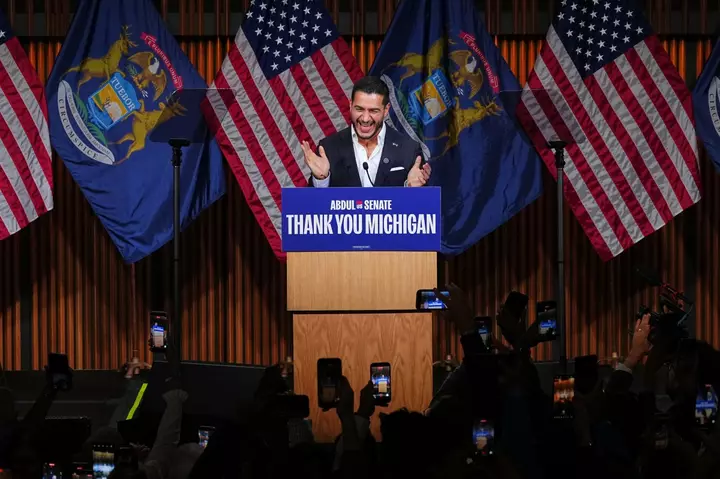
Democrats critical of Israel's war in Gaza won major congressional races Tuesday, including two Senate contests in Michigan and Maine. This dealt a significant setback to the American Israel Public Affairs Committee (AIPAC) and raised questions about its ability to shape the Democratic Party's position on Israel. The most consequential result came in Michigan, where Abdul El-Sayed defeated Republican Mike Rogers, despite a multimillion-dollar effort by AIPAC's super PAC to prevent him from becoming the Democratic nominee.
In Maine, Troy Jackson defeated Republican Senator Susan Collins, another setback for the pro-Israel organization, whose political action committee had supported Collins. Together, the victories suggest that opposition to unconditional American military assistance to Israel is becoming less of an electoral obstacle for Democratic candidates, including those competing in politically divided states. The results also point to a broader shift in U.S.-Israel relations that extends beyond the midterms.
Bar-Ilan University political scientist Jonathan Rynhold, says three pillars have traditionally sustained the relationship: bipartisan political support; the influence of the pro-Israel lobby in Congress; and Israel's strategic importance to the United States. Rynhold argues that the first has largely collapsed, the second has been substantially weakened and the third remains intact, although growing numbers in both parties are questioning whether Israel's military power is being used in American interests. The results also present a more complicated picture of AIPAC's influence: the organization and its allies defeated several prominent critics of Israel during the primaries, while many successful Democratic candidates campaigned primarily on economic issues.
El-Sayed's victory carries particular significance because of the scale of the effort to defeat him before the general election. According to the research compiled for this article, AIPAC's United Democracy Project (UDP) spent approximately $30.6 million during Michigan's Democratic primary; this includes roughly $20.1 million opposing El-Sayed and $10.5 million supporting his more moderate rival, Representative Haley Stevens. Those figures still require reconciliation with Federal Election Commission independent expenditure records.
El-Sayed subsequently defeated Rogers in the general election, becoming the first Muslim elected to the U.S. His success offers evidence that opposition to U.S. military assistance to Israel need not prevent a progressive Democrat from winning statewide. Michigan had voted for Donald Trump in 2024, making the outcome especially relevant to Democrats considering how to compete in swing states.
Bend the Arc CEO Jamie Beran, whose Jewish progressive organization supported the broader political movement, told Newsweek that voters had rejected attempts to divide communities over Israel. "AIPAC, tech bros and other special interests spent millions trying to defeat candidates like Dr. Abdul El-Sayed because he was critical of our tax dollars being used for unconditional military aid to Israel’s government," Beran said.
Extract — continue reading at the source.