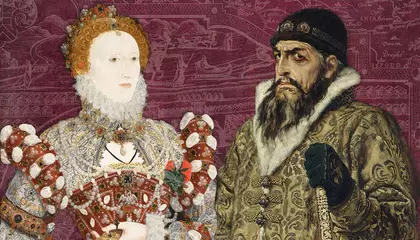
In October 1570, Ivan the Terrible ended a letter to Elizabeth I with the explosive line “I spit on you and your palace.” Unfortunately, the Russian czar had just murdered his most capable foreign ministers in a purge, meaning there was no one left who might have been able to restrain his language somewhat. Although badly rendered from the Russian and perhaps more equivalent to “awesome,” as in inspiring awe, Ivan’s epithet of “Terrible” was justly earned: He was mercurial, fond of torture and ever ready to scapegoat someone else for his own poor decisions. The only contemporary portrait of him is highly iconographic, showing a balding, slightly wrinkled and heavily bearded man with eyes like a sad beagle.
A later English visitor wrote that “he was a goodly man of presence, well favored, of a high forehead and shrill voice, a right Scythian, full of ready wit and wisdom, cruel and merciless.” Nonetheless, Ivan was a canny politician who ruthlessly held Russia’s vast lands together. When the czar wrote his letter to Elizabeth, he was bloodily consolidating power at home while riding high in a war against Sweden. He was appalled that England’s “Virgin Queen” had not succumbed to his far-off charms.
Elizabeth, on the other hand, had an attractive voice and a graceful step. Despite a hot temper, the Tudor monarch was well aware that she needed her people’s approval to enact power. By 1570, she had also been reigning alone for 12 years and—much to the despair of her councilors and Parliament—saw little need for a husband, having successfully survived the difficult early years of her reign without one.
To the amazement of much of Europe, this woman’s relatively small, wealthy island had not been invaded by a larger power, even though she remained shockingly single. Remaining unmarried had, in fact, proved to be an advantage: Whenever one hostile actor loomed particularly large, threatening invasion or a trade embargo, Elizabeth would suddenly enter marriage negotiations with a close relative, claiming that this time she really was serious about repairing the relationship through marriage. She would prolong these negotiations until the danger was over.
Losing her single status would, therefore, have been a huge diplomatic blow, cutting out this ever-present weapon out of her arsenal. Elizabeth had also watched her elder sister Mary’s disastrous marriage to Philip II of Spain. It ended in little except Mary’s unpopularity and the loss of Calais, England’s last remaining territory on the French mainland.
Elizabeth would often cite Mary’s misfortunes to explain why she avoided marriage, forever remaining the Virgin Queen. But what was a sensitive, paranoid despot to do when the queen of England refused to take his offer of marriage seriously, claiming not to understand his allusions to a closer alliance? For that was why Ivan had threatened to spit on the monarch: Although he hadn’t sent a letter baldly stating so to Elizabeth, he had alluded to a relationship cemented by family—presumably the precursor to proper marriage negotiations.
Extract — continue reading at the source.