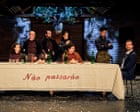
In February, turbulent scenes inside a German theatre made headlines around the globe. During the final act of a play at Schauspielhaus theatre in Bochum, the audience first jeered and whistled at a performer in the role of a far-right politician. An orange lobbed from the auditorium narrowly missed its target; eventually, two spectators climbed on to the stage and tried to wrestle the actor off.
News of the incident travelled around the world: it seemed a bizarre throwback to a world in which people were not able to tell the difference between art and real life, like 19th-century Parisians stampeding out of a cinema after watching a train hurtle towards the camera. For the man who wrote the play, however, it was nothing unusual. The play, which visits London’s National Theatre next month, tells the story of a macabre family tradition: once every year, a group of relatives gather over a feast of wild boar and asparagus in the southern Portuguese countryside to kill a fascist they have kidnapped.
Their ritual is designed to avenge the real-life murder of Catarina Eufémia, a harvester in revolt who was killed at the hands of the Salazar regime’s police force in 1954. But this year the family member tasked with the execution voices some doubts about the ritual’s righteousness, and things go awry: in the play’s last half hour, the freed fascist gives a victory speech that is uninterrupted by the rest of the cast. Ever since its September 2020 premiere in Guimarães, audiences have stepped in to intervene.
In Portugal, spectators chanted Grândola, Vila Morena, José Afonso’s song of the 1974 Carnation revolution, to drown out the actor’s words. In Italy, they sang anti-fascist resistance anthem Bella Ciao. In Austria, spectators stood up and walked out.
There were attempts to storm the stage and hit the actor impersonating the fascist politician at performances in Lisbon, Paris, Marseille and in Montreal. In other places, it was the far right that expressed its indignation: the Rome premiere of Catarina and the Beauty of Killing Fascists was met with protests from the local branch prime minister Giorgia Meloni’s Brothers of Italy party, which asked for the play to be removed from the programme. One answer may be that Catarina and the Beauty of Killing Fascists is essentially two plays in one, each of which annuls the answers offered by the other: an anti-fascist play that asks difficult questions of both liberal and militant anti-fascists.
For the first two hours, Rodrigues’s play is a reflection on what the philosopher Karl Popper called the “paradox of tolerance”: to preserve an open and tolerant society, must we be intolerant towards those who advocate intolerance? Or does our society cease to be a tolerant one when we do so? The second question carries particular weight in Rodrigues’s staging, for the anti-fascist tradition that the family at the heart of the play represents is one that comes across as self-absorbed, self-regarding and, in its own way, reactionary.
Extract — continue reading at the source.