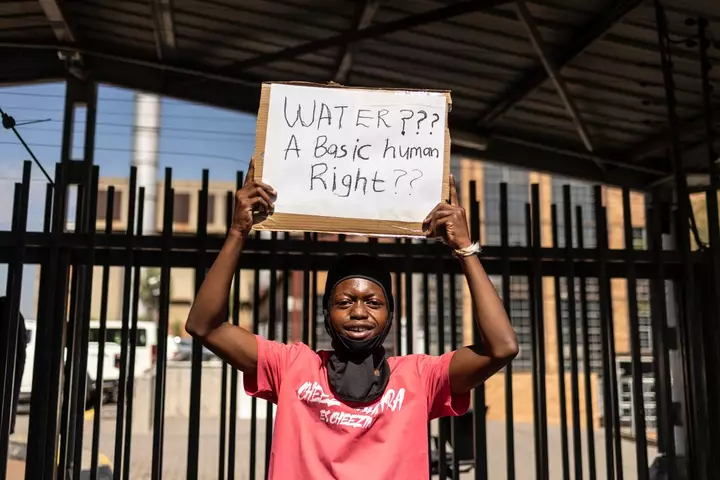
Johannesburg is in the throes of a crisis where people are sometimes more than a week without running water, and Newsweek has spoken to local supply researchers and engineers to explain why. Johannesburg, home to roughly 6.2 million people, is struggling with “severely constrained systems,” with authorities proposing new restrictions last week, including implementing supply cuts in certain areas. The issue has gone viral on social media, with an X post by Polymarket about the crisis garnering 8 million views as of Tuesday.
South Africans’ daily lives are being impacted drastically by water shortages. One woman, 59-year-old Sharlene Smith, spoke to Bloomberg about how the crisis forces her to cross a dangerous area enveloped in gang violence to try and fetch water from a church or a mosque to take back to her elderly mother. Businesses are also suffering, with a coffee shop owner telling local outlet The Star that he spends an entire day’s profit on refilling his backup tank.
It comes as South Africans go to the polls to vote in their local elections this week, putting service delivery at the center of the country’s focus. He acknowledged the impact of the shortages, saying: “Residents are now in their second week of disruption, and some households have had dry taps for more than 10 days." Morero said the city’s supplier, Johannesburg Water, was planning to acquire and use its own water tanker fleet of trucks to deliver water to informal settlements, neighborhoods of makeshift homes that surround the city. He also said water storage levels had risen from 37 percent on Monday to 41 percent on Tuesday.
When Newsweek contacted the mayor’s office for comment, it was directed to Morero’s speech. Newsweek has reached out to Johannesburg Water, via email, for comment. Johannesburg is one of the few major industrial cities in the world that is not on a river—its supply chain moves water from dams through treatment plants before it reaches pumping stations and municipal storage to eventually be used in homes.
Sheridan argued that “maintenance of the network has been negligible” with “thousands of kilometres of pipes that are not being maintained to global norms” while reservoirs and water towers have been left “leaky.” “We are now in the awful position where the maintenance backlog far exceeds any available budget, so we are essentially playing maintenance whack-a-mole,” he said. Sheridan added that the city also has “real supply constraints right now,” with the next supplying dam set to be usable in 2028 or 2029. All of this, along with the country’s growing population, “adds up to a very complicated, intersecting system that has created a perfect storm, which is why people don't have water.” Geography Associate Professor Anja du Plessis, of the University of South Africa, also told Newsweek that “sufficient water exists,” there are just large amounts of it getting lost through leaks while power outages, common in South Africa, interrupt the pumping needed to move the water through the system.
Johannesburg has been under “Level 1” water restrictions since September, which bans people from watering gardens or filling swimming pools during certain hours, and they cannot use hoses to wash paved areas and driveways. These rules are set to stay in place until March 31, but Johannesburg Water proposed stricter restrictions last week, including mandatory spray nozzles on hoses, stopping the irrigation of city-managed parks and using treated wastewater instead of drinking water for things like road construction. In areas where consumption is particularly high, targeted supply reductions could be introduced.
Extract — continue reading at the source.