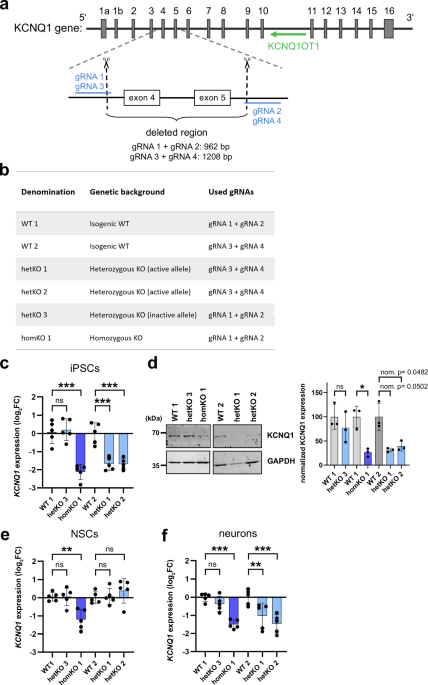
KCNQ1 encodes a voltage-gated potassium channel implicated in peripheral and neurological disorders, but its role in human neurodevelopment remains unclear. We generated KCNQ1 knockout (KO) human induced pluripotent stem cells and differentiated them into neural stem cells (NSCs) and cortical neurons. KCNQ1-deficient NSCs show impaired neurite outgrowth, linked to reduced cell adhesion and disrupted neural cell adhesion molecule signalling, a phenotype reproduced by pharmacological KCNQ1 inhibition.
Multi-omics and follow-up analyses reveal mitochondrial dysfunction, including reduced mitochondrial copy number and ATP synthase expression. KO cells also show impaired insulin signalling, with diminished insulin receptor gene expression and altered RAS-MAPK and PI3K-AKT pathways. In differentiated neuronal cultures, KCNQ1 loss decreases synaptic activity and maintains an immature transcriptional profile.
Together, these findings identify a role for KCNQ1 in regulating cell adhesion, mitochondrial function, insulin signalling, and neuronal maturation, expanding our understanding of processes that may contribute to neurological manifestations associated with KCNQ1-related disorders. KCNQ1 is the pore-forming alpha subunit of a voltage-gated potassium channel complex. It interacts with KCNE family members, which act as beta subunits, to assemble the functional Kv7.1 potassium channel1,2.
This channel generates a slow delayed rectifier current3. KCNQ1 is ubiquitously expressed in humans, though its function varies in different tissues2. In the heart, it is responsible for the main repolarizing potassium current, and for the regulation of the cardiac action potential duration3.
In peripheral organs such as the stomach, intestines, kidney, thyroid gland, and the respiratory system, KCNQ1 is expressed in epithelial cells. Here, it facilitates the transport of ions, hormones, and water, maintaining potassium homeostasis2. In the pancreas, it modulates insulin secretion from beta cells by regulating potassium channel currents4.
KCNQ1 is also expressed in multiple regions of the developing and adult brain in mice and humans. In neuronal tissues, it interacts with KCNE1 and is hypothesized to influence neuronal excitability5. Evidence for neuronal expression remains limited, although neuronal localization has been reported in two studies5,6.
Extract — continue reading at the source.