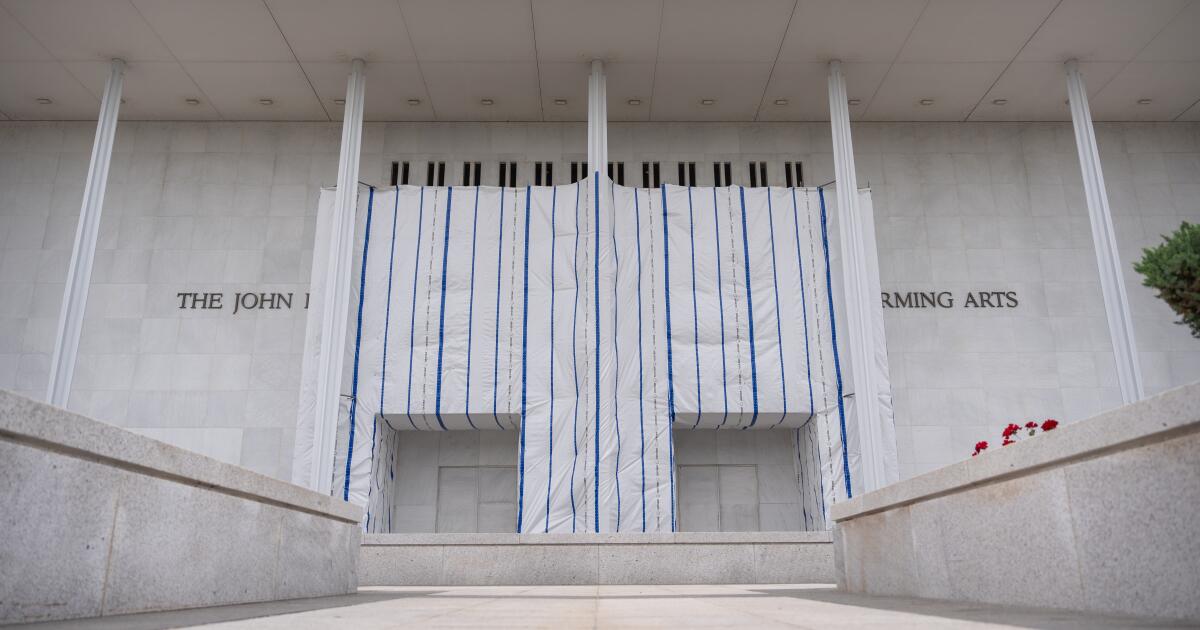
The Kennedy Center Board of Trustees voted Tuesday to immediately close the performing arts venue, a few hours after a federal judge ruled that President Trump’s name could not be restored to its facade, according to sources familiar with the situation. It remains unclear when the venue might actually close since U.S. Federal Judge Christopher Cooper would have to lift his preliminary injunction against the closure — an action that will almost certainly be fought in court.
The whipsaw turn of events came after a 57-page packet was distributed to the board over the weekend claiming the center was in egregious physical decline and nearly bankrupt — a prospect that could only be avoided with Trump’s help. It continues, if Trump is not “legally and appropriately recognized and acknowledged on the facade of the Kennedy Center,” it is doubtful he will agree to “carry the burden of managing the renovation and [provide] the Center with a much required financial rescue.” In a 22-page ruling Tuesday, Cooper wrote, “Simply put, Defendants cannot install memorials for President Trump or anyone or anything else at the Kennedy Center without Congress’s blessing.” Trump decried the back and forth in court, calling Cooper in a social media post “very hostile and conflicted” and alleging that the center “is in a virtual state of collapse.” The vote to shut down for a two-year $250-million renovation comes after previous efforts by the Trump-appointed board to close the venue and add Trump’s name have been stymied in court — most recently in May when Cooper first ruled that only Congress could rename the venue. Cooper did not rule that the board could not shut down the center, only that it should take more time to consider the issue.
In mid-August the board again voted to move forward with Trump’s plan to shutter the building for renovations and to inscribe Trump’s name on the facade. Tuesday’s vote solidified those plans, tying the closure and the need for Trump’s name to imminent bankruptcy and building conditions that it alleges are dangerous to staff and the public. Joyce Beatty of Ohio, an ex-officio member of the board, who sued late last year to block Trump’s name from being added to the facade, included the two new draft resolutions in a court filing Monday, hoping to get Cooper to consider them at a discovery hearing scheduled for Tuesday.
In her most recent filing, Beatty’s lawyers argued that documents distributed to the board of trustees over the weekend, which contained the draft resolutions and made the case for closure, “incorrectly asserts that the Delta Consulting Group considers the main building ‘unsafe for continued occupancy,’ when Delta expressly disclaimed providing any such opinion.” The filing also notes that the draft resolution “seeks to justify the closure by citing a recent leak in the building which caused a portion of the ceiling plaster to detach,” and notes that, “In the past, similar such defects appear to have been addressed without closing the Center.” “This constant effort to add Donald Trump’s name to the Kennedy Center facade is the definition of insanity,” said Beatty’s counsel, Norm Eisen of Democracy Defenders Action and Nathaniel Zelinsky of Washington Litigation Group. Worse still, now Trump is taking the Center hostage and threatening to in effect kill it unless he gets his way. This has to stop.” The Kennedy Center did not immediately respond to a request for comment about the closure.
This latest chapter in the battle over the future of the Kennedy Center comes after more than a year and a half of turmoil arising from Trump’s February 2025 decision to fire the center’s board and appoint himself chairman. The move set off a chain reaction that included an exodus of high-profile talent and shows — a trend that ramped up again last December when the board voted to rebrand the venue after Trump, placing his name above that of former President Kennedy. In February, Trump announced his plans to close the building for renovations beginning July 4, which was pushed back amid ongoing litigation.
The board notes that the center will continue to present educational and artistic programming at the venue’s new Reach expansion, and it will also still present the Kennedy Center Honors and the Mark Twain Prize for American Humor offsite. The proposal cited the center’s continuing support for the National Symphony Orchestra, which has also been performing at alternate venues.
Extract — continue reading at the source.