The findings come one year after the first-ever oxygen collisions at the Large Hadron Collider (LHC). All four of the collider's major research collaborations, ALICE, ATLAS, CMS and LHCb, have now reported signs that this primordial form of matter can emerge when oxygen and neon nuclei collide. The results challenge a long-standing assumption about the enormous forces needed to create such an extreme substance.
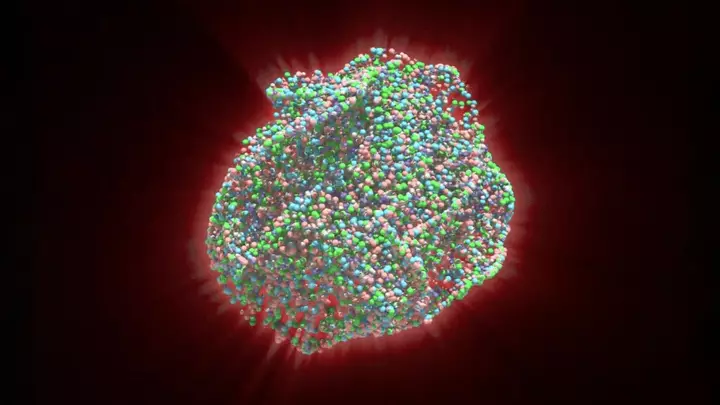
They also offer scientists a new way to investigate the conditions that prevailed during the universe's earliest moments. Quark–gluon plasma (QGP) is an unusual state of matter that appears under tremendous pressure and heat. At temperatures exceeding 100,000 times those at the Sun's center, particles such as protons and neutrons can no longer maintain their normal structure.
Instead, they break apart into quarks and the gluons that ordinarily bind them together. Physicists believe that this was the state of matter throughout the universe during the first millionths of a second after the Big Bang. Nearly 14 billion years later, researchers can briefly recreate these extraordinary conditions by smashing atomic nuclei together at extremely high energies inside the LHC.
For decades, scientists believed that generating this plasma required collisions involving very heavy atomic nuclei, particularly lead. Lead nuclei are more than 200 times heavier than the protons typically used in LHC experiments, making them capable of producing the intense conditions thought necessary for QGP to form. However, recent discoveries have increasingly called that assumption into question.
Earlier this year, the ALICE collaboration, which specializes in studying quark–gluon plasma, identified another indication of QGP formation in proton–proton and proton–lead collisions. The previous year, LHC researchers had also reported the first hints of this plasma emerging from oxygen–oxygen collisions. Now, more detailed investigations have revealed multiple signs that QGP can form in collisions involving both oxygen and neon nuclei, providing stronger evidence that the conditions required to create this primordial matter are not limited to heavy atomic collisions.
One of the clearest ways to identify quark–gluon plasma is to examine what happens when energetic quarks and gluons travel through it. As these particles move through the extremely hot and dense material, they lose some of their energy. Scientists call this process parton energy loss, and it provides an important clue that QGP has formed.
Extract — continue reading at the source.