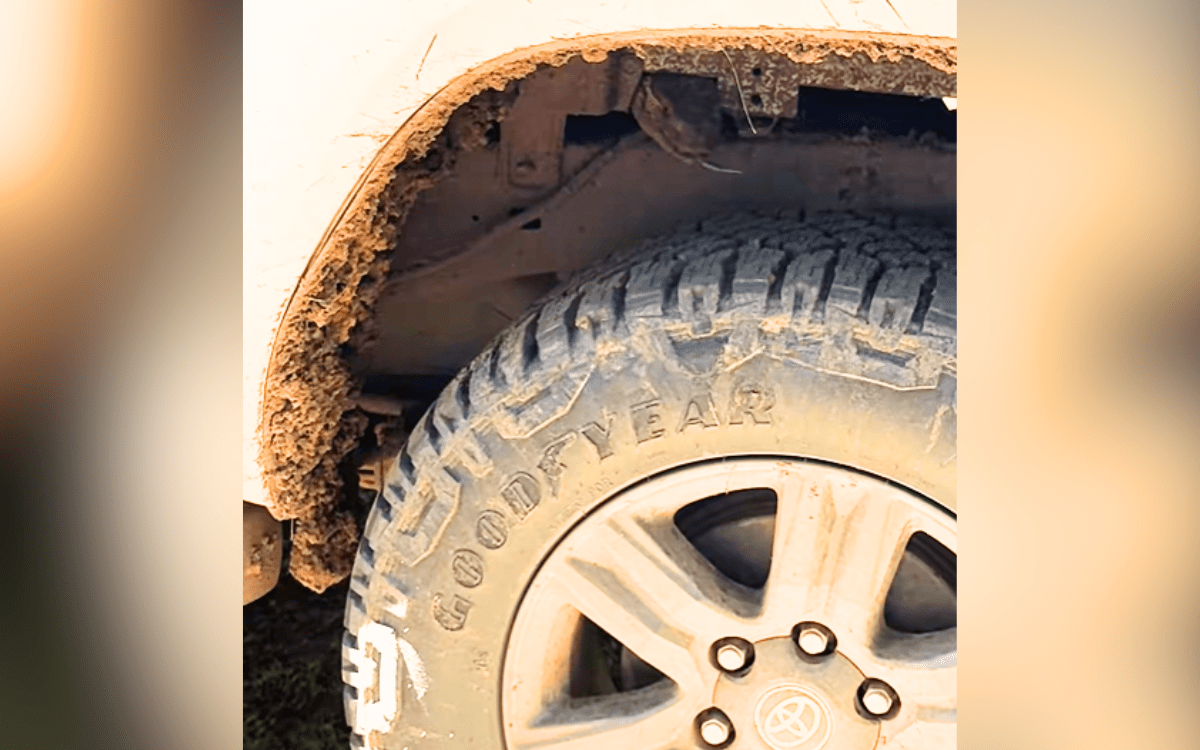
A U.S. businessman thought he had a punctured tire during a recent trip to South Africa, but the reality was a little more alarming. Mike Scarborough was returning to his truck after an excursion in the South African bush when he heard a distinct hissing sound coming from one of the vehicle's wheel wells. "I first heard it when we jumped out the back of the truck," Scarborough told Newsweek.
"I thought it was a hole in the tire at first. I got down to check and saw it, then jumped back." Bending down to get a better look inside the wheel well, Scarborough soon realized the noise wasn't coming from the tire itself but from a large reptile that had somehow found its way inside and was in no mood to come out. Scarborough recalled feeling a "quick panic" when he first locked eyes with the animal.
At that point, he didn't know what species of reptile he was dealing with. I just knew it was a giant lizard," he said. "It climbed in while we were parked in the bush." Scarborough eventually got help removing the lizard from the wheel well.
That was when he learned he was dealing with a monitor lizard, which he was told would "definitely bite" if disturbed from its new resting spot. Chad Keates is a South African herpetologist known for his research on reptiles and amphibians. According to Keates, South Africa is home to two species of monitor lizard: the Nile monitor and the rock monitor.
He attributes some of the apprehension surrounding these reptiles to the fact that they are often confused with crocodiles because of their large size. Monitor lizards are Africa's largest lizards and occupy a somewhat similar ecological niche. However, according to Keates, both species are largely harmless.
Rock and Nile monitors are nonvenomous, though they may bite or lash out with their tails if they feel threatened. Keates notes that monitor lizards pose little threat to people and that injuries generally occur when humans attempt to catch or handle them. Though the encounter may have come as a shock to Scarborough, a 2024 study published in the journal Landscape Ecology found hundreds of recorded sightings of Nile monitors living near people, including in urban areas, with no indication of a broader pattern of attacks on humans.
Extract — continue reading at the source.