A federal judge has struck down Texas' law restricting certain drag performances for a second time, marking the latest legal setback for efforts by Republican-led states to regulate drag shows and other LGBTQ-related expression. District Judge David Hittner ruled Tuesday that Texas Senate Bill 12 is unconstitutional, reaffirming a decision he first reached in 2023. The law had sought to restrict what it described as "sexually oriented performances" and was widely promoted by supporters as a measure aimed at drag shows.
"Finally, for those who find such activities as described in this case offensive, the solution is relatively simple … just don't go," Hittner wrote Tuesday. Texas Attorney General Ken Paxton has pledged to appeal the ruling. Newsweek reached out to his office for comment Wednesday morning.
The decision arrives amid a yearslong national battle over drag performances, transgender rights and LGBTQ visibility, with several Republican-led states passing laws designed to limit drag shows while Democratic-controlled states and civil rights organizations have moved to protect such performances as a form of constitutionally protected expression. "Efforts to restrict drag are part of a much larger, coordinated campaign over recent years attacking LGBTQ people across virtually every aspect of life," Logan Casey, director of political research at the Movement Advancement Project (MAP), told Newsweek. "This latest Texas ruling joins similar decisions in Montana, Florida, and Tennessee, where courts have found these laws to be unconstitutional restrictions on free speech." Texas is not alone on the issue.
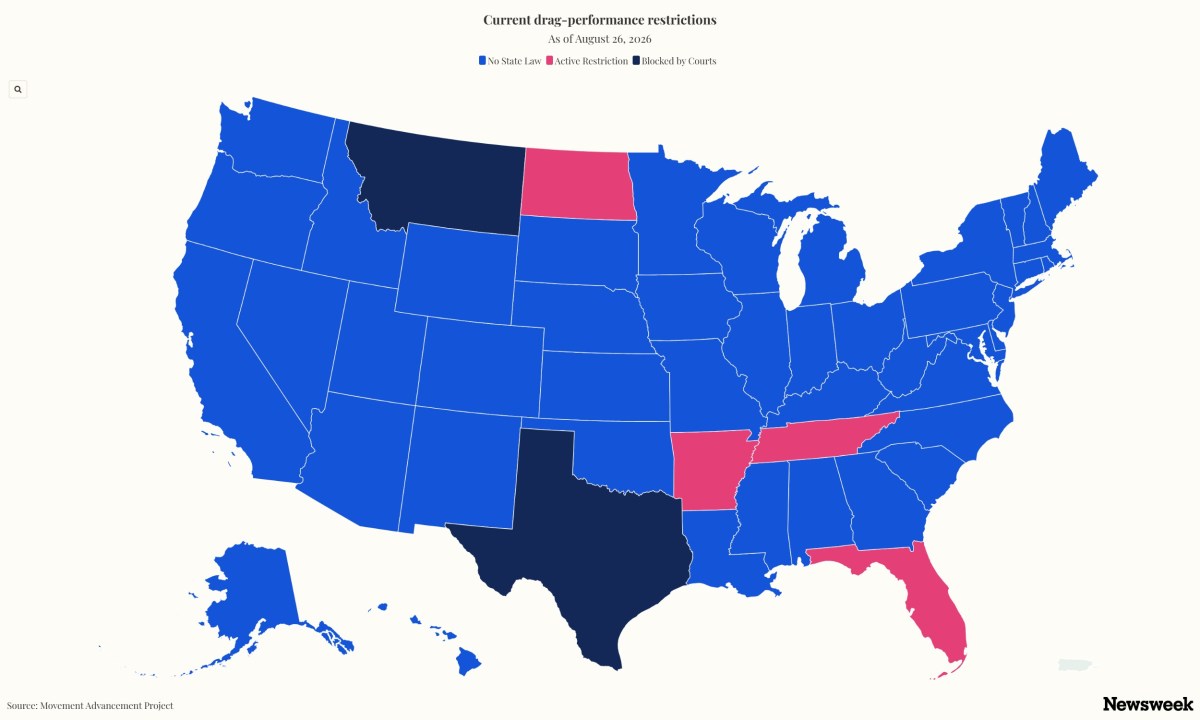
According to the Movement Advancement Project, six states currently have laws that either explicitly restrict drag performances or could be used to target them through broader regulations on adult or sexual performances. Tennessee and Montana enacted laws that explicitly restrict drag performances, while Arkansas, Florida, North Dakota and Texas adopted laws concerning adult-oriented performances that advocates say could be used against drag events. Some of these measures remain tied up in ongoing legal battles.
Supporters of the laws have often argued they are designed to prevent children from being exposed to sexually explicit material in public spaces. Critics, however, say the measures are intentionally written to target LGBTQ communities and suppress artistic expression protected by the First Amendment. The Texas ruling echoed concerns raised by other courts that some of the laws are too broad and risk encompassing a wide range of protected speech and performances.
"Legislators appear to have recognized this fundamental flaw, at least for now," Casey said. "Unlike many other anti-LGBTQ policies in recent years, drag restriction laws have not spread across the country: the first laws of this kind—including in Texas, Montana, Florida, and Tennessee—were enacted in 2023, and no more have been enacted since 2023. All those states I mentioned were promptly sued after passing their laws, and all were blocked by court order within a matter of months." While Republican lawmakers in some states have pursued restrictions, Democrats elsewhere have moved in the opposite direction.
Extract — continue reading at the source.