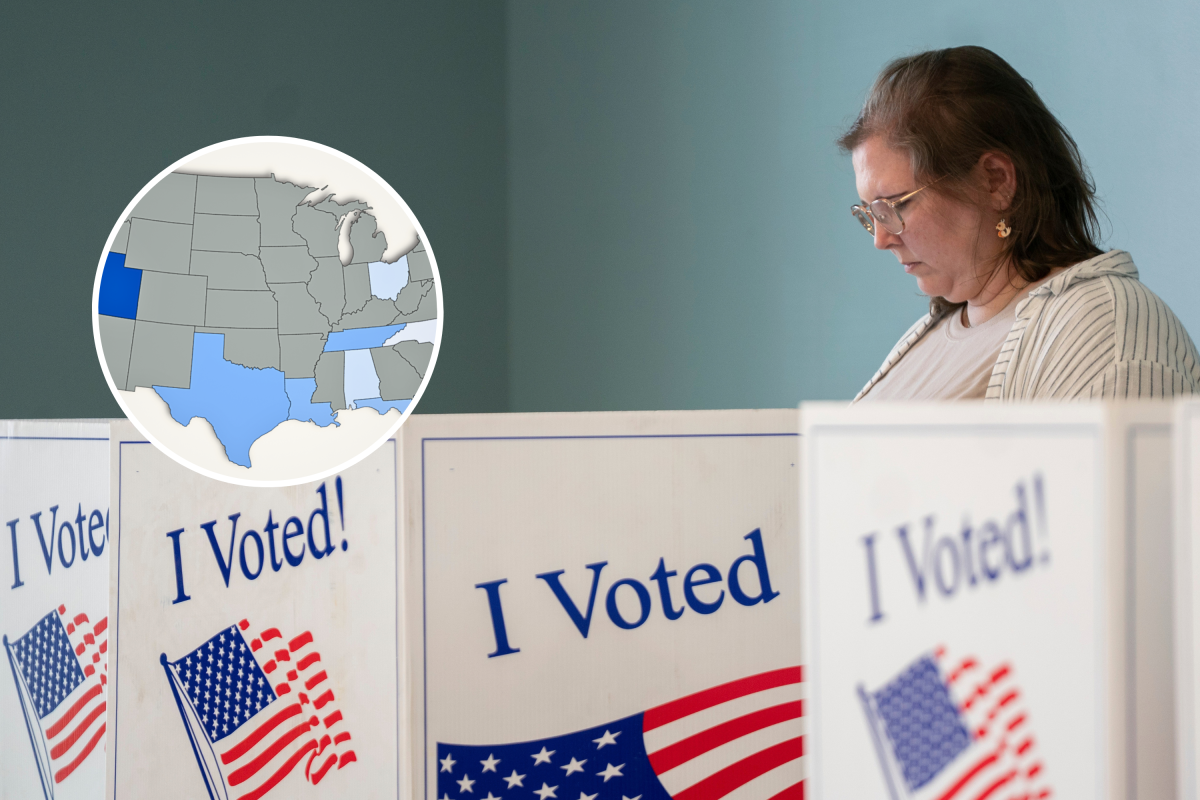
A partisan redistricting battle sparked by President Donald Trump has moved an estimated 34.8 million Americans into new congressional districts across nine states ahead of the November 2026 midterms, a new analysis has found. A new study from Protect Democracy, which describes itself as a nonpartisan, nonprofit group working to "prevent American democracy from declining into a more authoritarian form of government," found that roughly one in 10 Americans was placed in a different congressional district between 2024 and 2026, according to U.S. census data. The current so-called "redistricting wars" began when Trump pressed Republican-controlled Texas to redraw its House map for partisan advantage, prompting Democratic-led California to respond with its own voter-approved plan.
Texas recorded the largest reassigned population, at more than 10.4 million, while Utah experienced the biggest proportional change, with 69.1 percent placed in different districts, according to Protect Democracy’s report. "If this trend continues, it really brings into question whether or not elected officials are really representing their constituents anymore, or if the voters are being randomly picked by mapmakers to squeeze out partisan advantage," Ben Raderstorf, a policy advocate at Protect Democracy and one of the paper’s co-authors, told The . Newsweek contacted Protect Democracy via email for further comment on Friday morning and is awaiting a response.
Hover over each highlighted state in the map below to see how many people were reassigned to a new congressional district and the share of the state’s population affected. What began as an attempt to improve Republican prospects in Texas became a wider contest over control of the House, with each party facing pressure to answer the other side’s gains rather than leave seats on the table. Protect Democracy says the result is the largest modern wave of mid-decade redistricting, reviving a practice once common in the 19th century but rare during the past 50 years.
The nine-state overhaul is striking both for the number of people affected and for how quickly it unfolded. Congress usually reconsiders boundaries after the once-a-decade census, giving candidates, election officials, and voters time to adjust before the next contest. That norm broke down after Trump began pushing states to redraw outside the regular cycle in 2025.
Texas moved first that summer, followed by Florida, California, Tennessee, North Carolina, Ohio, Alabama, Louisiana and Utah. The report says most of those maps were designed to maximize partisan advantage, although it identifies Ohio and Utah as arguable exceptions. New lines can leave voters evaluating candidates who did not appear on their previous ballot or represented another area during the last Congress.
Election administrators may also have to revise ballot combinations, polling arrangements and voter information on compressed schedules. "We tend to talk about political parties as the ‘winners’ or ‘losers’ of gerrymandering, but voters are the ones who pay the price," Raderstorf said. "When legislative maps change, voters can find themselves in a new district with a new polling place and new representative—without ever even knowing it.
Extract — continue reading at the source.