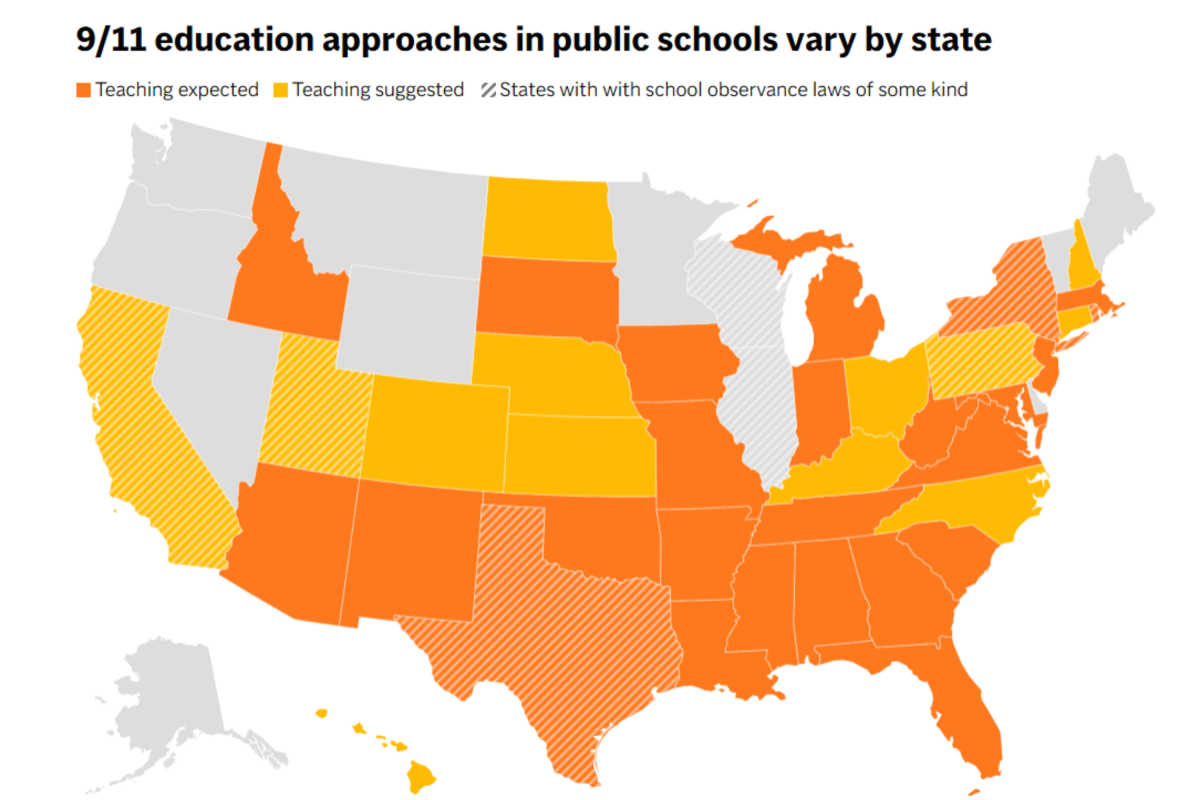
As the U.S. prepares to mark the 25th anniversary of the September 11 terrorist attacks, a growing number of states have adopted policies requiring or encouraging schools to teach students about one of the most defining events of modern American history. According to The (AP) research, at least 40 states expect or suggest public schools address 9/11 in some way. Among them, 25 states have laws or education standards that specifically require or expect instruction on the attacks, while another 13 include optional references to 9/11 in educational guidance.
Several additional states require or recommend observances such as moments of silence, bringing the total number of states with some type of 9/11-related policy to at least 40. About one-third of Americans were born after al-Qaida terrorists hijacked four commercial airliners and killed nearly 3,000 people in New York City, at the Pentagon, and near Shanksville, Pennsylvania, meaning today's students are actually quite far removed from the catastrophic events of September 11, 2001. Jeremy Stoddard, an education professor at the University of Wisconsin who researches how schools teach 9/11, told Newsweek that teachers increasingly view the attacks as a historical event rather than a lived experience, with many now emphasizing how post-9/11 policies continue to affect students today.
Newsweek has also emailed Megan Jones, the September 11 Memorial & Museum's education chief, for comment and is awaiting a reply. States vary widely in how they approach teaching 9/11. Some require dedicated classroom instruction about the attacks and their aftermath, while others embed the topic more broadly within U.S. history, civics, or discussions about terrorism and foreign policy.
Some states only encourage schools to commemorate the anniversary through observances or moments of reflection. Some states require students to examine not only the attacks themselves but also their long-term impact. For example, Alabama's standards require students to study U.S. military involvement following the attacks and evaluate the effectiveness of America's response, including the creation of Homeland Security and passage of the Patriot Act.
Arizona lawmakers enacted a statewide requirement for "age-appropriate education" on or around each 9/11 anniversary, though the requirement was later narrowed to grades seven through 12. Education experts say teaching 9/11 has become more important as fewer students have any personal connection to the attacks. Stoddard told Newsweek that this generational shift presents a challenge for educators because many students, and an increasing number of teachers, have no direct memory of the attacks.
"They just do not have the same emotional connection, the collective memory experience," he said. While teachers often share personal stories about where they were on September 11, "they will never have that same connection." "Even worse than getting started wrong or using inappropriate language is the total omission of telling the story," Gordon Felt, whose brother Edward Felt died aboard United Airlines Flight 93, told educators during a seminar at the Flight 93 National Memorial in Pennsylvania. "That's our biggest fear." Teachers gathered at the memorial this summer to discuss how best to educate a generation born long after the attacks.
Extract — continue reading at the source.