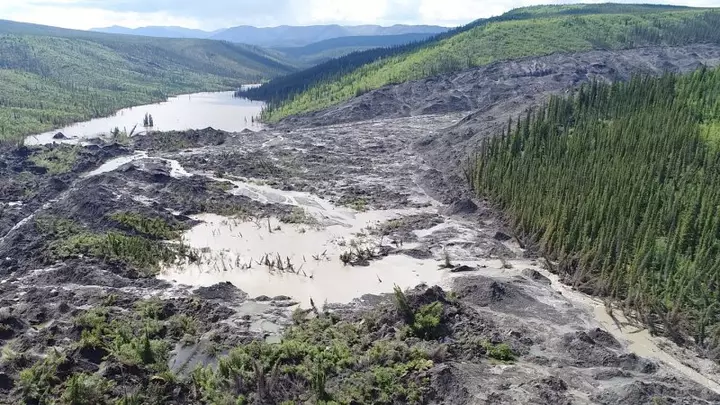
In 2018, a strange and enormous landslide occurred in Canada’s Northwest Territories. A slab of earth roughly equivalent in volume to seven Great Pyramids of Giza suddenly began sliding downhill, leaving behind a barren scar in the forested landscape. But what puzzled scientists was that the slide had initiated in frozen ground that had been glued in place for years.
An analysis of the event reveals that it represents a new class of catastrophic landslides called permafrost detachment slides, researchers report in the Sept. 28 Geophysical Research Letters. The slides may be set in motion by wildfires that occurred decades earlier, destabilizing the ground and opening cracks through which water infiltrated deep underground. Over time, that water may have thawed the frozen layer from below, eventually unleashing the entire frozen layer in a catastrophic slide.
Large landslides don’t normally mobilize so much still-frozen material, and when they do begin in thawing layers they usually move slowly, says Dmitry Nicolsky, a geophysicist studying permafrost at the University of Alaska Fairbanks who was not involved in the study. But he says this new research suggests scientists need to better study what’s occurring beneath the surface in permafrost regions, because “we don’t know how [the ground] will move — it might go slowly or it might go catastrophically.” The inspiration for the research manifested in 2019, when permafrost geologist Joseph Young, based at the University of Alberta in Edmonton, Canada, at the time, was helicoptering to a field site in the Northwest Territories to assist a colleague’s research. In some of the valleys out there, the slopes were “just collapsing with landslides everywhere,” says Young, who is now at an engineering firm in Edmonton.
That was surprising because they were in an area where the permafrost — ground that has been frozen for at least two consecutive years — shouldn’t have been thawing much. Once on the ground, more puzzling details emerged. But at some of the landslide sites, large blocks of still-frozen ground seemed to have been moved hundreds of meters, he says.
Young and his colleagues studied two of the largest slides in the region that had moved big chunks of permafrost. These were the 2018 slide, which mobilized 18 million cubic meters of earth and dammed the Redstone River, and another event in 2017 that moved 4.5 million cubic meters of material. Field observations revealed that both events had initiated along flat sliding surfaces roughly 20 meters underground, where the permafrost layer’s base was identified.
Meanwhile, satellite observations showed that the ground at both sites had been gradually moving meters each year for decades. Young and his colleagues hypothesized that climate warming and wildfire had somehow played a role in causing the slides. They set up instruments nearby that tracked ground temperature from 2020 to 2022, focusing on spots either with undisturbed forest or where wildfire had burned about 25 years earlier.
Extract — continue reading at the source.