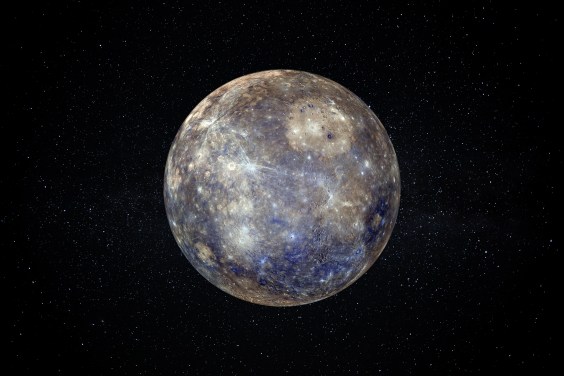
Mercury is roughly 100 million miles closer to Earth than Mars, but it takes a lot longer to get there. For example, NASA’s MESSENGER space probe launched in 2004 but didn’t insert into an orbit around Mercury until 2011. The 2005 Mars Reconnaissance Orbiter, on the other hand, was whizzing around Mars less than a year after launch.
Well, the sun’s massive gravity well prevents a straight shot—the spacecraft would be traveling too fast to decelerate. So instead MESSENGER had to circle around several times, using the gravity of Earth and Venus to slow down and spiral in. Once in place, the probe performed a series of highly elliptical flybys, mapping the surface of the first planet from the sun.
Read more: “After an 8-Year Journey, Orbiters Are About to Give Us a Fresh Look at Mercury” Unfortunately, the shape of the flybys resulted in some areas of the surface—those surrounding the north pole—getting a more detailed digital rendering from MESSENGER’s laser-based altimeter than others. To compensate, a team of planetary scientists were able to combine the laser data with global image-based digital terrain models to develop a higher resolution map of the planet’s surface roughness. Now scientists from that team have come to a somewhat surprising conclusion—Mercury is shrinking more than previously thought.
Mercury is very hot, but in its early days constant bombardment from other rocky materials made it a lot hotter. As it cooled, its surface cracked and wrinkled, producing “shortening structures” in the crust. These wrinkles tell the story of how much shrinkage occurred, which could offer important clues to the composition and evolution of the planet.
Using their new maps, the team discovered some of these telltale wrinkles may be obscured by debris from impacts. Because shrinkage is expected to occur uniformly as the planet cools, the team was able to use data from visible sites to fill in gaps in areas blocked by debris and get a more complete picture of planet-wide shrinkage. They found that Mercury likely shrunk 10 percent to 30 percent more over its lifetime, contracting the planet’s diameter up to 14.5 miles (compared to previous estimates of 2.5 to 10 miles).
That’s because the new estimates are more in line with predictions based on physics. Still, the researchers say even these figures could be an underestimate. The good news is that we’ll have more data soon.
Extract — continue reading at the source.
/https://tf-cmsv2-smithsonianmag-media.s3.amazonaws.com/filer_public/94/be/94be7181-550d-4831-ac94-9672b56da5e3/formimagining_copy.jpg)




/https://tf-cmsv2-smithsonianmag-media.s3.amazonaws.com/filer_public/3d/0b/3d0b0830-44fd-4131-b9c8-34e31c737957/brain-implant.png)