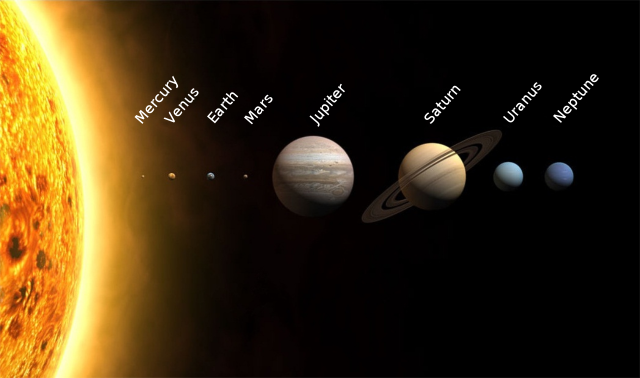
In terms of power, the only body of note in the Solar System is the Sun. Planets, in general, reflect, absorb, and re-radiate energy emitted by their parent stars, and the Sun is the only parent star any of the planets have here in our Solar System. To an excellent approximation, the Sun keeps not only Earth, but all the planets at a temperature well above what they’d be without it, which is just a few Kelvin. (Without an external heat source, most planetary temperatures would equilibrate at the same temperature as the cosmic microwave background, or-270 °C / -455 °F.) Therefore, you’d think that proximity to the Sun, or the planetary order of our Solar System, would be the overwhelming factor in determining a planet’s temperature.
Indeed, this works incredibly well for nearly all of the planets in our Solar System. Neptune, the most distant planet from the Sun, is also the coldest planet. Moving inwards: Finally, continuing our inward journey, we make it to the innermost planet of all, Mercury.
There, we find that its daytime temperature — when its immersed in full sunlight — reaches a whopping 800 °F (427 °C) at maximum. Then, at night, when it faces away from the Sun, the temperature plummets, dropping all the way down to lows of -180 °C (-290 °F). But even at its absolute hottest, Mercury never reaches the temperatures achieved on Venus, which remain steady, day-and-night, at between 440–480 °C (820–900 °F): always hotter than Mercury at its absolute hottest.
Here’s the science of how. The way that light spreads out as a function of distance means that the farther away from a power source you are, the energy that you intercept drops off as one over the distance squared. This also illustrates, if you view a certain specific angular area (illustrated by the squares) from the perspective of the original source, how larger objects at greater distances will appear to take up the same angular size in the sky.
Each time you double your distance between a source and observer, the brightness you observe gets quartered. In general, photons (and all light) propagate spherically outward away from the emitting source. It makes sense that the closer you are to a star — or any source of light — the greater the amount of its emitted light will hit you.
If two planets were in orbit and one were twice as far away from its parent star as the other, the farther one would only receive one-quarter of the sunlight-per-unit-area as the innermore one would. If a planet were three times as distant, it would receive just one-ninth the sunlight-per-area that the innermore one received. However, a planet’s various orbital parameters cannot be the only factor that determines how hot they are.
Extract — continue reading at the source.





/https://tf-cmsv2-smithsonianmag-media.s3.amazonaws.com/filer_public/55/9c/559c3e43-f760-48c8-978b-1faec1bf964e/nobel-chem.jpg)