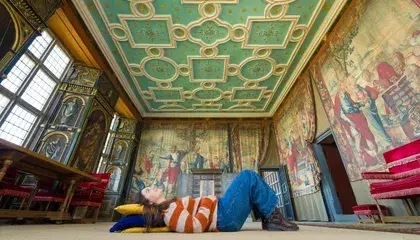
Historic buildings across England are encouraging visitors to spend some time considering what often goes over their heads: the oft-forgotten art of ceilings. The conservation charity English Heritage's “Lie Down and Look Up” campaign, which runs through November 1, highlights five distinctive ceilings across the country. In each room, space has been created and cushions provided to help visitors get as comfortable as possible while looking up—supine if they like—and experience details and craftsmanship they otherwise may have neglected.
Designed to inspire awe, they can be wonderfully distinctive—with decoration that survives remarkably well,” Jeremy Ashbee, head curator of properties at English Heritage, says in a statement. The room’s name derives from the 254 sparkling gold-leaf stars adoring its teal ceiling, which was originally painted dark blue. Painted wall panels and tapestries depict biblical stories playing out beneath the ceiling’s constellations.
The castle’s creator, William Cavendish, clearly had an eye for decadent ceilings. Painted in 1619, the ceiling of a letter-writing room affectionately called the Heaven Closet shows a swirling scene of Christ’s ascension into heaven surrounded by dozens of cherubs. The star-gazing effect is also evident at Northumberland’s Belsay Hall, both a medieval castle and Greek Revival mansion, which was inspired by designer Sir Charles Monck’s time in Greece.
Built in the early 19th century, Belsay’s New Hall evokes Greek marble temples and offers a connection to the outdoors via a rectangular glass roof. Compared to the four other sites featured by English Heritage, which have “quite ornate ceilings,” Woolley says, Belsay is unique for its “stark” design. How have visitors found lying down and looking up at Belsay?
The room was originally designed by Rudyard Kipling’s father, Lockwood Kipling, as a banquet hall to honor Victoria’s status as Empress of India. The room’s walls and ceiling feature ornate plaster designs, overseen by Bhai Ram Singh, a master craftsman at India’s Mayo School of Art. The massive peacock mantlepiece alone took 26 craftsmen some 500 hours of labor to create.
The bright white room is framed by dark teak wood accents and features ornate objects gifted to Victoria. Closer to London, ceiling gazers can view two other distinct artistic styles and epochs. Built in the 1830s, Bedfordshire’s Wrest Park is a French chateau-inspired mansion that was used to film scenes in the Netflix period drama “Bridgerton.” Its drawing room is home to an elaborate ceiling painting of Venus and Cupid flying through the sky.
Extract — continue reading at the source.