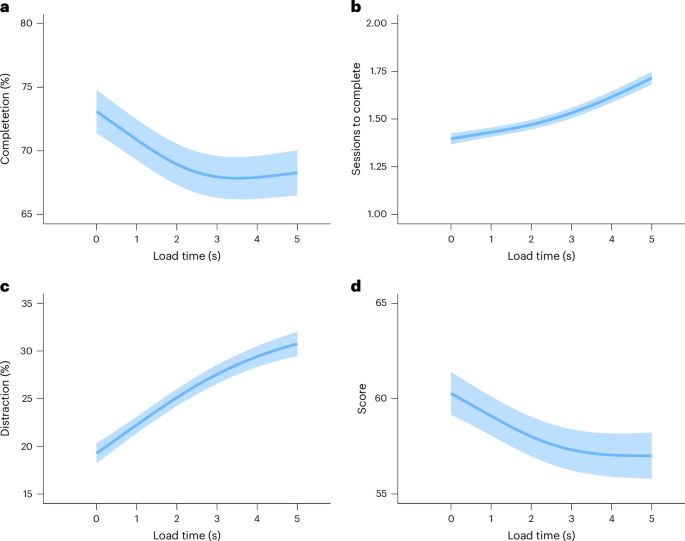
We examine an overlooked feature of modern education: ‘microdelays’—brief loading lags that could hinder learners with slower internet connections. In two longitudinal quasi-experimental field studies, microdelays as short as 1–2 s predicted impaired learner engagement and achievement. When faced with microdelays, US primary and secondary school students (N = 26,707) completed fewer online math assignments, took longer to complete assignments, were more likely to get distracted mid-task and earned lower scores.
Likewise, when aspiring coders, primarily in Latin America (N = 55,184), experienced microdelays, they spent less time actively engaged, multitasked more often, completed fewer lessons and were less likely to attain a key course milestone. Our results held across a range of model specifications, and leverage within-person variation in load times to support a causal interpretation. These findings identify microdelays as a hitherto-overlooked barrier in online learning.
This is a preview of subscription content, access via your institution Access Nature and 54 other Nature Portfolio journals Get Nature+, our best-value online-access subscription Receive 12 digital issues and online access to articles Prices may be subject to local taxes which are calculated during checkout Data and materials associated with this Article are available via OSF at https://osf.io/xyfpt. It includes data for K–12 student analyses, as well as the preliminary representative survey, randomized experiment and media coverage analyses. To prevent identification of individual schools in the dataset, noise was introduced to school-level demographics.
All analyses reported in this Article used the original (non-noised) variables. Consequently, the results generated when reproducing analyses with school-level demographics will not be identical to those reported here. Data from our second dataset (on aspiring coders) can be made available upon reasonable request by contacting Asaf Mazar at [email protected].
All efforts will be taken to respond to requests within 30 days. Source data are provided with this paper. Code associated with this Article is available via OSF at https://osf.io/xyfpt.
Online Education – Worldwide https://www.statista.com/outlook/emo/online-education/worldwide (Statista, 2025). The EdTech Top 40: K–12 EdTech Engagement During the 2024–25 School Year https://www.instructure.com/edtech-top40 (Instructure, 2025). The end justifies the definition: the manifold outlooks on the digital divide and their practical usefulness for policy-making.
Extract — continue reading at the source.


