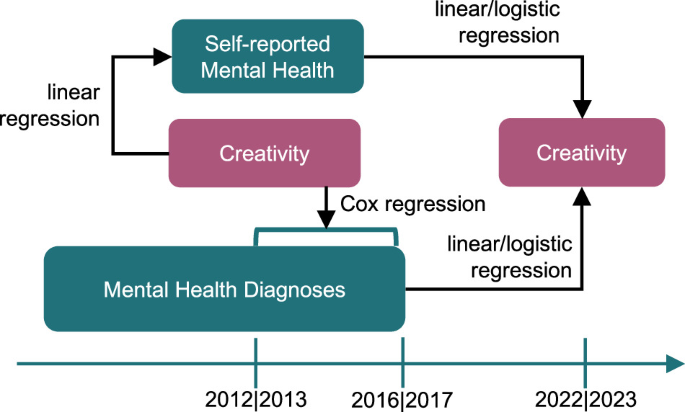
Existing findings of creativity and mental health associations are inconsistent, partly due to heterogeneous assessment of creativity and mental health. Consequently, basic questions concerning the direction and domain specificity of these associations remain unanswered. This comprehensive study used data from 14 658 Swedish twins, including a genotyped subsample, and employed a range of genetically informed and longitudinal designs to examine the direction, nature, and underlying mechanisms of the creativity–mental health relationship.
Creativity was assessed broadly, using different measures of artistic and scientific achievement, occupation, personality (openness), and psychometric creativity (divergent thinking). Mental health was measured using both self-report data and registry-based diagnoses. Higher artistic creativity, as indexed by artistic achievement and openness, was associated with worse mental health (e.g., psychosis proneness, major depressive disorder, and anxiety disorder).
In contrast, measures of scientific creativity showed predominantly non-significant, or even negative, associations with mental health problems, particularly in the case of occupational creativity. Co-twin control and polygenic score analyses suggested that shared genetic factors played an important role in the observed associations, with the exception of a potential causal association between depressive symptoms and openness, which persisted even in the longitudinal co-twin control model. Genetic correlations further showed shared underlying genetic influences.
In summary, our findings offer novel evidence for a complex, bidirectional, and genetically influenced association between artistic creativity and mental health, helping to clarify mixed results in the prior literature. Creativity, broadly defined as the ability to form novel and valuable ideas or to find new solutions to problems [1], has long been suggested to be associated with psychiatric disorders [2]. This idea is fueled by many anecdotal examples of famous creators with eccentric personalities and psychiatric problems, from Vincent van Gogh and Ernest Hemingway to Virginia Woolf and Camille Claudel [3].
More recently, research including some systematic reviews and meta-analyses, has suggested that creativity and engagement in creative activities are associated with an increased risk of mental health problems [4, 5]. For example, creative professions were associated with a higher risk of bipolar disorder [6], music playing with more psychosis-like experiences [7, 8], and artistic achievement with multiple mental disorders [9]. However, the literature shows inconsistencies.
For example, Cuypers et al. [10] found music-related creative activities to be associated with better perceived mental health. Similarly, art-related cultural activities were associated with less depression in older adults [11] and more social well-being in young adults [12]. Furthermore, a recent scoping review for the World Health Organization [13] on the role of arts in improving health and well-being, strongly advocates for cultural activities on prescription as a medical intervention.
Extract — continue reading at the source.