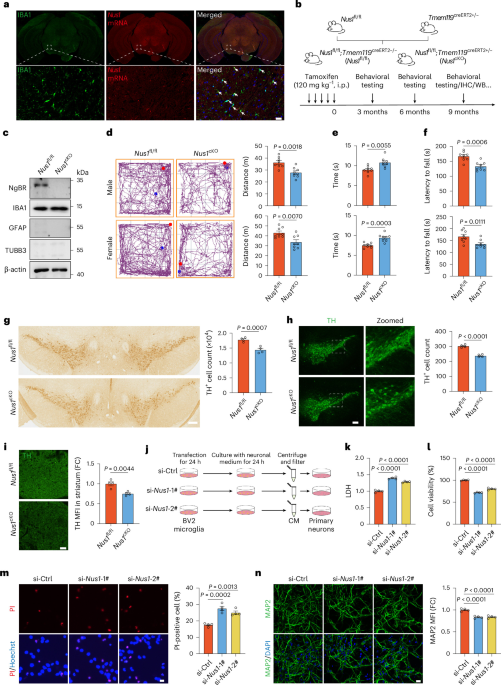
The selective loss of dopaminergic neurons in the substantia nigra pars compacta is a defining feature of Parkinson’s disease (PD), yet its underlying mechanisms remain unclear. NUS1, which encodes neurite outgrowth inhibitor-B receptor (NgBR), was recently identified as a PD risk gene. Here we show that NgBR is highly expressed in microglia, where its deficiency drives progressive PD-like motor deficits and dopaminergic neurodegeneration via the LCN2–SLC22A17 iron-transport axis in mice.
NgBR deficiency in mouse and human microglia triggers endoplasmic reticulum stress and PERK–ATF4–NUPR1 signaling, which preferentially induces LCN2-mediated iron efflux over cytokine release. Subsequently, microglia-derived iron-loaded Holo-LCN2, but not iron-free Apo-LCN2, is internalized by SLC22A17, a receptor highly expressed in dopaminergic neurons, leading to iron overload and ferroptosis. Pharmacological inhibition of LCN2–SLC22A17 axis or ferroptosis alleviated dopaminergic neuron loss and PD-like symptoms caused by microglial NgBR deficiency in vitro and in vivo.
Our findings identify disrupted intercellular iron homeostasis as a pathological driver of PD and highlight the LCN2–SLC22A17 axis as a potential therapeutic target. This is a preview of subscription content, access via your institution Access Nature and 54 other Nature Portfolio journals Get Nature+, our best-value online-access subscription Receive 12 print issues and online access Prices may be subject to local taxes which are calculated during checkout The supporting data for this study are provided in the paper and supplementary materials, and source data are provided with this paper. The raw and processed RNA-seq data are deposited at the GEO (GSE301569 and GSE318178).
Single-cell RNA-seq datasets of human midbrain (GSE157783)20 and mouse midbrain (GSE306642)21, and single-nucleus RNA-seq datasets of human cortex (GSE174332)22 and mouse cortex (GSE229169)23 were obtained from GEO. All mouse strains and reagents used in this study were commercially sourced; detailed information is available in Methods. Source data are provided with this paper.
All customized R scripts for single-cell and single-nucleus RNA-seq data preprocessing, bioinformatics analysis and visualization for NUS1/Nus1 expression analysis in this study are publicly available via GitHub at https://github.com/BioWalking/scRNA-seq-Analysis-of-Human-and-Mouse-Brain. Challenges in the diagnosis of Parkinson’s disease. Lancet Neurol. 20, 385–397 (2021).
Article PubMed PubMed Central CAS Google Scholar Deliz, J. Epidemiology of Parkinson’s disease: an update. Coding mutations in NUS1 contribute to Parkinson’s disease.
Extract — continue reading at the source.


