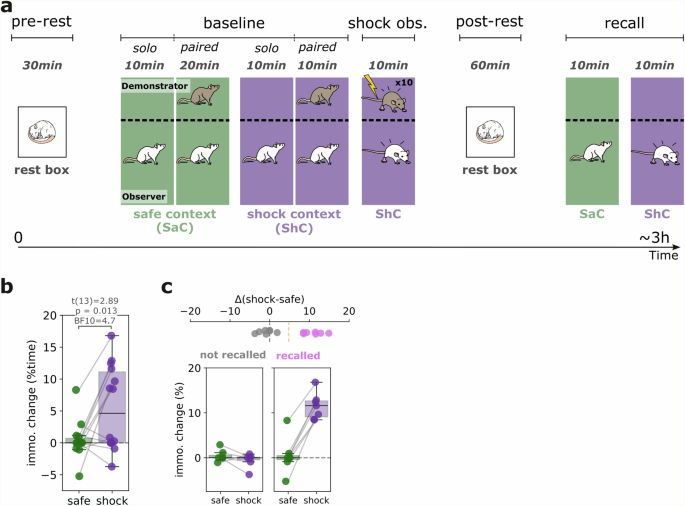
Learning where danger lurks by observing others requires linking another individual’s distress to one’s own representation of space. How the hippocampus implements this mapping is unknown. We recorded Neuropixels activity across the dorsal, intermediate and ventral hippocampus of male rats during contextual fear learning by observation, subsequent rest and recall.
Observers showed increased immobility in the context where they had witnessed a conspecific receive footshocks, with substantial inter-individual variability. Pyramidal neurons were recruited by shock observation, with enriched shock-excited cells in the intermediate hippocampus. In the dorsal and intermediate hippocampus, shock-observation responses scaled with baseline place-field firing, revealing a gain-like conjunctive code between observed distress and observer’s position.
Following learning, shock-context spatial representations were selectively stabilized in the intermediate hippocampus, and post-learning sharp-wave ripples preferentially reactivated shock-context ensembles, especially in animals expressing contextual freezing. These findings identify candidate hippocampal mechanisms by which socially acquired threat information are mapped onto the observer’s spatial representation and consolidated into memory. To safely navigate their environment, animals must learn where danger lies.
Learning from others’ misfortunes is safer than relying on direct experience. Mounting evidence suggests that rodents orient towards conspecifics in altered affective states1 and can exhibit distress when witnessing the distress of others2,3,4. Notably, they show elevated freezing when re-exposed to the context in which they previously witnessed a conspecific receive shocks3,5, indicating that they can associate others’ distress with the context in which it was observed.
At the mechanistic level, neurons involved in first-hand distress are activated when rodents witness the distress of others in cingulate Area 246, and interfering with activity in Area 24, the basolateral amygdala, midline thalamic nuclei, or dorsal hippocampus disrupts observational fear learning3,5,6,7,8. However, these findings leave unresolved a key question: if animals can learn where danger lies by observing others, how is this socially acquired information incorporated into the hippocampal cognitive maps that guide behavior? The hippocampus is a key structure for forming these cognitive maps that support flexible navigation9.
During active experience, pyramidal neurons fire in a location-specific manner, collectively forming a spatial representation of the environment that can integrate internal states and task variables10,11,12,13,14,15,16,17. Individual experiences are associated with unique patterns of activity across hippocampal populations18,19. The stabilization of these representations is linked to learning20,21, and their reinstatement contributes to memory retrieval22,23,24.
Extract — continue reading at the source.


