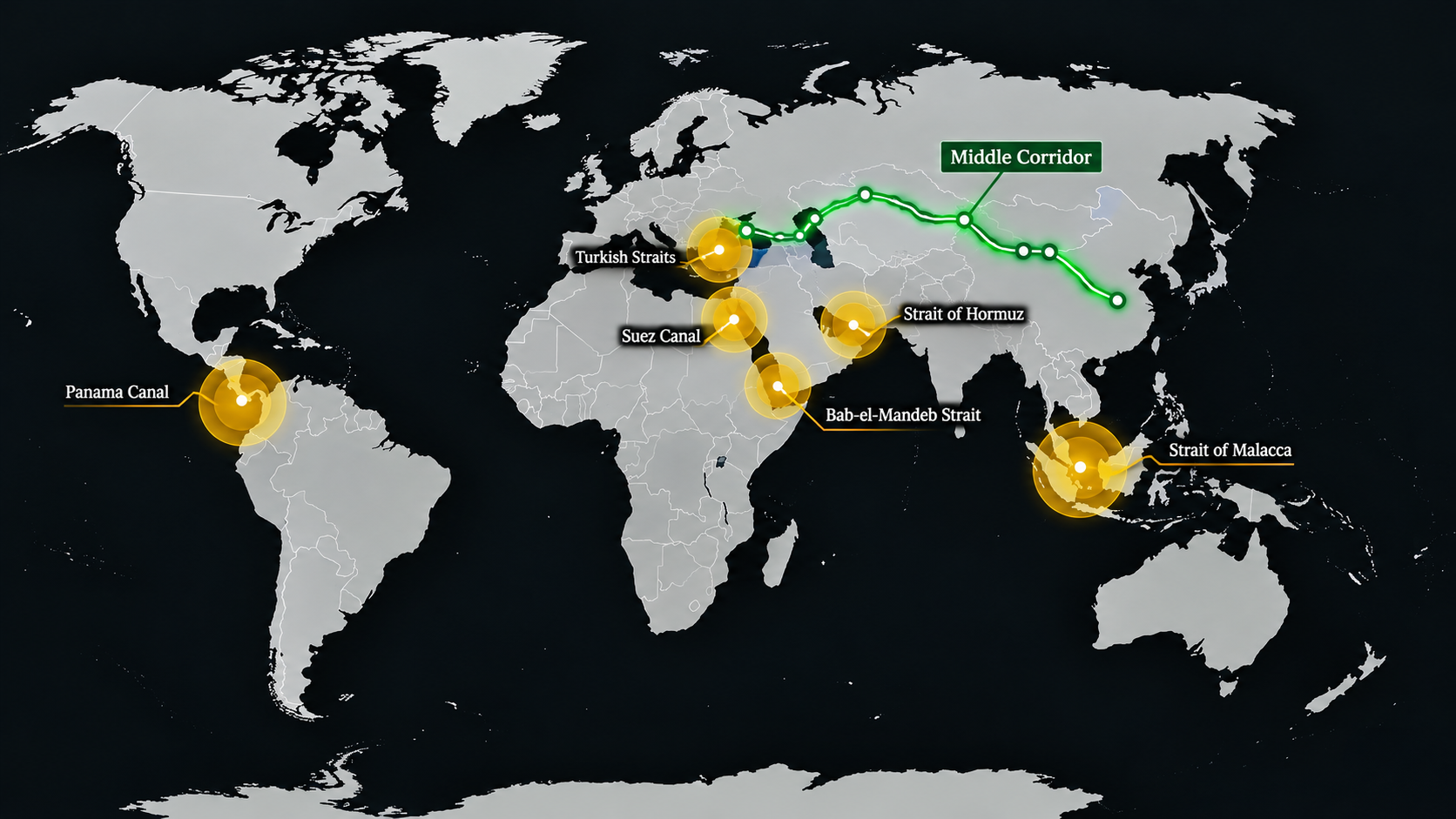
The vulnerability of global trade routes is once again forcing governments and logistics companies to reconsider how goods move between continents. From the Bab el-Mandeb Strait and the Suez Canal to other strategically important maritime passages, geopolitical tensions have exposed the risks of relying heavily on a limited number of transport arteries. Disruptions at these chokepoints can affect shipping schedules, insurance costs, commodity prices and the reliability of international supply chains.
Against this backdrop, the Middle Corridor, also known as the Trans-Caspian International Transport Route, is attracting increasing attention as an overland and maritime connection linking China and Central Asia with Azerbaijan, Georgia, Türkiye and European markets. Unlike traditional ocean routes, the corridor combines railway, Caspian Sea shipping, port infrastructure and road transport. Its strategic importance lies not simply in offering an alternative geographical route, but in creating additional options for cargo operators seeking to reduce their exposure to disruptions elsewhere.
Yet the development of the Middle Corridor raises a more complicated question. Greater demand does not automatically translate into greater efficiency. Limited vessel capacity, differences in customs procedures, infrastructure constraints and the need for coordination between several national transport systems remain significant challenges.
Azerbaijan occupies a central position in this emerging network. Through the Port of Baku, its railway connections with Georgia and Türkiye, and its wider transport infrastructure, the country provides a crucial link between the eastern and western sections of the route. The development of additional connections, including those envisaged through the Zangezur Corridor, could further diversify the regional transport network.
Speaking to AzerNEWS, transport expert Rauf Aghamirzayev examined the Middle Corridor's growing relevance, the limitations that must be addressed and the possibility of developing a more coordinated security framework among participating countries. In other words, competition persists there, despite all the risks. This does not mean that maritime transport has lost its relevance due to these risks—in fact, even today, despite the lengthening of routes, 90% of cargo is still transported by sea.
This has, in turn, increased the importance of multimodal transport and brought the issue of developing alternatives for each region to the forefront. Furthermore, regarding overland transport, the significance of the ‘Middle Corridor’—which operates on a multimodal basis—has also grown. Over the last decade, various infrastructure projects have been implemented, with others still underway.
Extract — continue reading at the source.