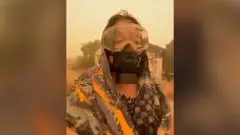
This article has been reviewed according to Science X's editorial process and policies. Editors have highlighted the following attributes while ensuring the content's credibility: Wildfires in the Mediterranean region are becoming drastically more intense. The recent major fires in France, Spain and Greece show that firefighting efforts are reaching their limits.
An international research team led by the University of Göttingen and the University of Kassel is therefore calling for a fundamentally new approach to landscape design: In the journal iScience, the researchers demonstrate that wildfire prevention should be conceived and planned in conjunction with nature conservation, agriculture and rural development. Using 10 landscape planning initiatives in the Mediterranean region as a basis, the team investigated how they affected wildfire risk. The models ranged from extensive grazing with cattle, sheep and goats (to reduce combustible biomass) to controlled burning and collaboration among the agricultural and forestry sectors, nature conservation organizations, the scientific community and the fire services.
The result: Initiatives that combined different forms of land use, actively involved various social groups and continuously refined their measures proved particularly successful. The researchers are therefore advocating a shift in wildfire management from a predominantly reactive approach to firefighting toward a long-term, preventive approach to shaping resilient landscapes. "Wildfires are not just a problem for the forestry sector, but the result of complex interactions between climate, land use and societal developments.
Our findings show that successful wildfire prevention combines ecological, economic and social objectives and brings relevant stakeholders together," explains lead author Dr. Elsa Varela from the Spanish National Research Council (CSIC), who coordinated the study as a Humboldt Fellow at the Chair of Socio-Ecological Interactions in Agricultural Systems at the Universities of Göttingen and Kassel. "A new landscape-based approach offers the opportunity to combine wildfire prevention with biodiversity conservation and sustainable land use.
This leads to solutions that are ecologically effective and socially viable," emphasizes Professor Tobias Plieninger from the same chair. "This requires stable partnerships, long-term funding and joint learning processes between science, policy and practice." Elsa Varela et al, Capitalizing on integrated landscape approaches for wildfire risk mitigation in the Mediterranean region, iScience (2026). DOI: 10.1016/j.isci.2026.116741 BSc Life Sciences & Ecology.
Microbiology lab background with pharmaceutical news experience in oil, gas, and renewable industries. Full profile → Bachelor's in mathematical biology, Master's in creative writing. Well-traveled with unique perspectives on science and language.
Extract — continue reading at the source.