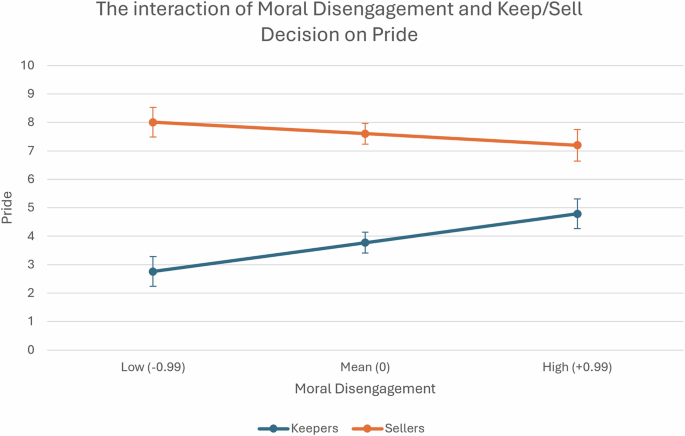
Despite widespread concern about environmental sustainability, people frequently choose financially beneficial but environmentally harmful options over costlier but more sustainable alternatives. Across four studies (total N = 817), we show that positive beliefs about greed and moral disengagement consistently predict self-interested, environmentally unsustainable choices in financially costly tradeoff situations. Moral disengagement does not operate primarily as a means of maintaining a positive moral self-image after making an unsustainable decision.
Instead, preexisting moral disengagement provides a pathway for self-interested choices, resulting in greater pride and lesser guilt relative to those who choose the environment over self-interest. The perceived morality of tradeoff decisions operated similarly but did not fully explain emotional reactions. These findings suggest that moral disengagement, rather than explicit moral evaluation, plays a central role in shaping environmentally consequential decisions and the emotions that follow, offering insight into the psychological processes that sustain unsustainable behavior.
As the damaging effects of climate change continue to increase across the world, and the costs to lives, livelihoods, and property pose existential challenges, few would argue against the urgent need for solutions. Likewise, many people probably feel that to solve our problems, businesses must change their traditional “profit at all costs” approach and adopt more sustainable practices to prevent even worse outcomes to the natural world. Indeed, most people want to live sustainably, and over 60% of consumers claim to be willing to pay more for sustainable products1.
However, there is a wide gap between claims and actions, known as the “intention–behavior gap” or “attitude–behavior gap2,3. That is, people’s goals of making sustainable choices are not always translated into sustainable behaviors, as they are unlikely to give up the financial benefits of environmentally unfriendly choices4. Although research on why people choose—or fail to choose—to engage in environmentally friendly behavior is not new5, understanding motivations for engaging in sustainability-relevant behaviors remains critical, as significant and immediate behavioral changes are necessary for achieving global sustainability targets6.
Thus, understanding the psychological underpinnings of behaviors and behavioral changes is crucial for research as well as practice6. The underlying determinants of pro-environmental behavior are debated. Some researchers argue for the role of intent-based, motivation-related perspectives, whereas others emphasize impact-oriented, outcome-based perspectives7.
However, motivations and means can clash. In particular, personal moral norms are critical in driving prosocial and pro-environmental behavior8,9, as many people believe it is their moral obligation to care for nature10. Yet, moral behavior in the domain of acting sustainably can be expensive, forcing choices between costly moral behaviors or acting in financial self-interest11.
Extract — continue reading at the source.


