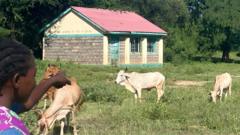
More cows than pupils - what is behind mass school closures in rural Kenya? ni Primary School has lost most of its pupils over the last three years On what should be a busy morning at Kaliluni Primary School in southern Kenya, only cows are in attendance, grazing between broken classroom doors that hang open to reveal rows of empty chairs.Three years ago, more than 200 children filled this rural school with noise and activity. Now there are only five pupils - and on the day we visit they, and the only remaining teacher, are absent. As we leave the dilapidated compound, with books strewn across the floors of some classrooms, we spot a schoolgirl in uniform walking forlornly towards her home.Maureen Mwisiwa, 12, says she has been turning up to school for the past week to find herself on her own."I feel bad missing lessons all those days while pupils in other schools are still in class," she tells the BBC.
Her mother, Josephine Muasya - like the remaining parents with children there - is planning to transfer her daughter to another school where most of Maureen's friends are now. It is quite a distance away - 8km (5 miles) on rough roads.But as there is no public transport in this remote area of Kitui county, which is more than 200km east of the capital, Nairobi, the children opt for a short cut, trekking over fairly rugged terrain.It will still take Maureen just over an hour to walk to the new school, instead of the 10 minutes to Kaliluni Primary."I was hoping the government would restore operations here - bring more teachers and facilities to accommodate the new curriculum - but there is no hope," her mother says.Muasya is referring to a major shake-up of Kenya's education system that was introduced in 2017 - a less exam-orientated and more creative and practical approach to teaching, known as Competency-Based Education (CBE).But it is having a devastating effect on rural junior schools - and Kaliluni Primary is one of more than 2,000 across the East African nation now facing possible closure as enrolment numbers plummet. /* sc-component-id: sc-bdVaJa */ .sc-bdVaJa .rPqeC{overflow:hidden;display:-webkit-box;display:-webkit-flex;display:-ms-flexbox;display:flex;background-color:#F2EFEC;-webkit-flex-direction:row;-ms-flex-direction:row;flex-direction:row;-webkit-flex-wrap:wrap;-ms-flex-wrap:wrap;flex-wrap:wrap;box-sizing:border-box;} /* sc-component-id: sc-bwzfXH */ .sc-bwzfXH .isWqFJ{width:100%;height:100%;object-fit:cover;object-position:50% 50%;position:absolute;background-size:cover;background-position-x:50%;background-position-y:50%;background-image:url('https://c.files.bbci.co.uk/assets/e7c0d603-0c0a-4f50-bbf2-6af7325d264e');} /* sc-component-id: sc-htpNat */ .sc-htpNat .kUePcj /* sc-component-id: sc-bxivhb */ .sc-bxivhb .huvKBR @media (max-width:599px)} @media (min-width:600px) and (max-width:1007px)} @media (min-width:1008px)} /* sc-component-id: sc-gzVnrw */ .sc-gzVnrw .blLFIH /* sc-component-id: sc-htoDjs */ .sc-htoDjs .kGbKV /* sc-component-id: sc-dnqmqq */ .sc-dnqmqq .dHUwnI .dHUwnI p @media (max-width:599px)} @media (min-width:600px) and (max-width:1007px)} @media (min-width:1008px)} /* sc-component-id: sc-iwsKbI */ .sc-iwsKbI .jiPRqw /* sc-component-id: sc-gZMcBi */ .sc-gZMcBi .honXkL /* sc-component-id: sc-gqjmRU */ .sc-gqjmRU .klLnaG .klLnaG > strong @media (max-width:599px)} @media (min-width:600px) and (max-width:1007px)} @media (min-width:1008px)} @font-face @font-face @font-face @font-face @font-face @font-face @font-face @font-face @font-face @font-face @font-face @font-face @font-face @font-face @font-face @font-face @font-face @font-face @font-face @font-face @font-face BBC The CBE curriculum should strengthen schools, especially for low-income communities, not weaken them" Tabitha KatinguA parent in Kitui countyUnder the old system, primary schools would teach children until grade eight and then aged around 14, they would move to senior school.Now the final year of primary school ends in grade six and there is a new intermediary stage, known as junior secondary school, for grades seven to nine, which includes more science and practical subjects.It was decided that primary schools would accommodate these intermediary grades with children moving to senior school at around 15 years old.But it meant that suddenly under-resourced primary schools needed more classrooms, science laboratories, additional teachers with subject specialisations and new learning materials."Infrastructure gaps are acute. Many rural schools lack basic facilities such as laboratories, yet learners are expected to pursue science and technical pathways," Mark Kasyoki, an education expert, told the BBC.He warned that the new curriculum, which was designed to address inequality in education - free for all children in Kenya - could end up doing the opposite if the problems were not urgently addressed.Other schools in Kitui county have also been affected.
Sooma Primary School shut in 2023 after its enrolment dropped to just six pupils and the following year Manooni Primary School closed its doors after only three pupils registered.There were no farewell assemblies, no tearful speeches under a mango tree. The children just quietly migrated, one by one, to better-equipped schools. irl used to attend Manooni Primary School, which is near her home, but she now has to walk 3km to the nearest school"The CBE curriculum should strengthen schools, especially for low-income communities, not weaken them," said Tabitha Katingu, a mother from the area, who has transferred her two children, meaning they now have a 3km walk to school."We want the best for our children. If a school has not enough trained teachers and other required facilities - why would we waste time there?"It has left many teachers frustrated too."The challen
Extract — continue reading at the source.