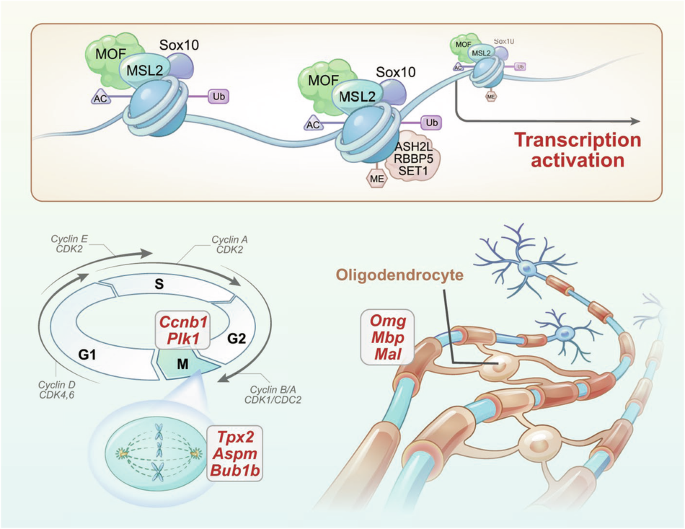
Pathogenic variants in MSL2, a core component of the histone-modifying MSL complex, are associated with neurodevelopmental disorders (NDDs) and white matter abnormalities; however, their mechanisms of pathogenicity remain unknown. In this study, we identified three patients with NDD carrying MSL2 variants, all of whom exhibited white matter abnormalities. Using conditional knockout mice, we demonstrated that oligodendrocyte lineage-specific deletion of Msl2 disrupts oligodendrocyte precursor cell proliferation, maturation, and myelination in a cell-autonomous manner, leading to autism-like behaviors including social deficits and repetitive behaviors.
Integrated transcriptomic and epigenomic profiling revealed that MSL2 maintains H3K4me3 occupancy at promoters of genes essential for cell cycle progression, mitotic spindle assembly, and myelination, whereas its loss aberrantly activates immune-related pathways. Furthermore, a cell synchronization study confirmed that MSL2 is required for metaphase spindle formation in oligodendrocyte precursor cells, providing a mechanistic basis for impaired oligodendroglial development and hypomyelination. Our findings establish MSL2 as a critical epigenetic regulator of oligodendrocyte lineage progression and propose MSL2-targeted interventions as a promising therapeutic strategy for NDD-related white matter defects.
Neurodevelopmental disorders (NDDs) are a group of conditions associated with abnormalities of the neurological system and developmental deficits1. Autism spectrum disorder (ASD) and schizophrenia are two major NDDs characterized by overlapping symptoms such as communication difficulties and social withdrawal. These symptoms, originating from altered brain development, can be attributed to maldeveloped myelin in the brain, among other factors2,3,4.
Recent genomic studies have identified recurrent de novo variants in MSL2 (male-specific lethal 2), a histone modifier within the MSL complex, in patients with NDDs exhibiting white matter hypomyelination, including delayed myelination and corpus callosum thinning5,6,7. This clinical link between MSL2 dysfunction and myelination defects highlights the need to explore the role of MSL2 in the cellular process underlying NDD-related white matter abnormalities (WMAs). Notably, previous investigations into MSL2 function have largely relied on in vitro assays, non-mammalian model organisms (e.g., Drosophila), and human cell lines8,9,10.
These studies established that MSL2 partners with MOF (KAT8) to catalyze H4 acetylation (H4K16ac), a mark of open chromatin, and acts as an E3 ubiquitin ligase targeting H2B (e.g., H2BK34ub, H2BK120ub), thereby facilitating H3 K4 and K79 methylation via 'trans-tail' crosstalk. All these histone modifications are well-recognized drivers of transcriptional activation. Importantly, the constitutive knockout of Msl2 in mice is embryonically lethal11, which prevents investigation of cell type-specific functions of MSL2, particularly in oligodendrocytes (OLs), the myelinating cells of the brain.
The precise role and mechanism of MSL2 in brain development, especially in OL-mediated myelination, remain unresolved. Myelination by OLs in the brain enables saltatory conduction of action potentials and provides long-term trophic support for axons12. The formation of mature myelinating OLs is a complex process tightly coordinated spatially and temporally by genetic and epigenetic events13,14.
Extract — continue reading at the source.