Susceptibility to chronic social stressors often results in the development of mental health disorders including major depressive and anxiety disorders. In contrast, some individuals remain resilient even after repeated stress exposure. Understanding the molecular drivers underlying these divergent phenotypic outcomes is crucial.
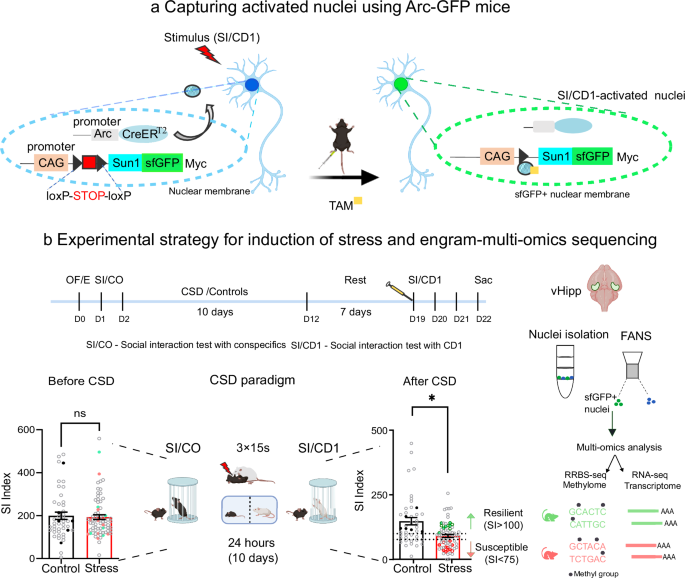
However, previous studies using the chronic social defeat (CSD) stress model have been limited by the use of bulk tissues investigating single omics domains. To overcome these limitations, here, we applied the CSD mouse model to Arc-GFP mice for investigating the mechanistic divergence between susceptibility and resilience, specifically in stress recall-activated nuclei. By conducting an in-depth analysis of the less-known differential methylome landscape in the ventral hippocampus, we noted unique phenotype-specific alterations in multiple biological processes with an overrepresentation of GTPase-related mechanisms.
Interestingly, the differentially methylated regions were enriched in ETS transcription factor binding sites (TFBSs), important targets of the Ras-ETS signaling pathway. This differential methylation in the ETS TFBSs could form the basis of persisting stress effects long after stressor exposure. Furthermore, by integrating the methylome modifications with transcriptomic alterations, we delineated the GTPase-related mechanisms differentially activated in the resilient and susceptible phenotypes with alterations in endocytosis overrepresented in the susceptible phenotype.
Overall, our findings reveal novel insights underlying the resilience-susceptibility divergence. Chronic social stress forms one of the most common stressors in humans and has been widely studied in rodents using chronic social defeat (CSD) stress models [1,2,3,4,5]. Physiologically, stress is the body’s natural response to a stressor, facilitating the escape from a situation or initiating behavioral adaptations for survival [6, 7].
However, chronic stress can be detrimental. Chronic stress-triggered hyperactivation of the hypothalamic-pituitary-adrenal (HPA) axis results in dendritic atrophy [8] and loss of synapses [9, 10] in multiple brain regions via different signaling cascades. Such disruptions increase the risk for various disorders, including sleep disturbances [11, 12], psychiatric disorders [13, 14], and neurodegenerative diseases [15, 16].
Apart from this, constant exposure to stress can also lead to debilitating conditions, including cardiovascular disorders [17] and cancer [18, 19]. Interestingly, despite exposure to chronic stress, a fraction of the population develops adaptive stress-coping strategies (resilience) in contrast to a maladaptive coping strategy (susceptibility). Molecular studies using transcriptomic approaches in both bulk tissues and specific cell types have contributed immensely to the understanding of resilience and susceptibility [5, 20, 21] mechanisms.
Extract — continue reading at the source.


