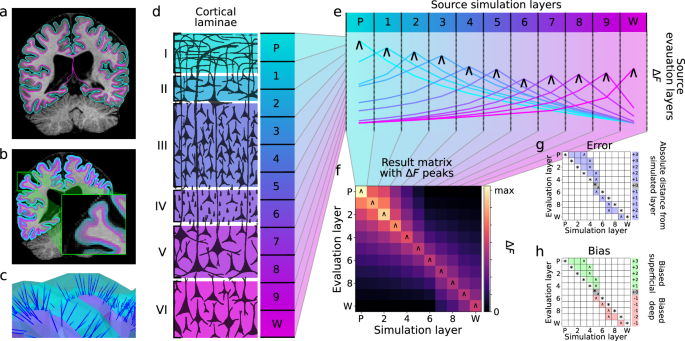
Neural dynamics at the laminar level are critical for cortical computation. However, in humans, non-invasive methods to probe such dynamics have been limited to coarse distinctions between deep and superficial layers. Here, we present a multilayer magnetoencephalography source reconstruction framework and evaluate the conditions under which depth-resolved laminar inference may be feasible.
Using simulations, we systematically assess the limits of magnetoencephalography depth resolution, showing that laminar discrimination depends on sufficiently high signal-to-noise ratio, precise co-registration, and accurate specification of cortical column orientation. We demonstrate that regional variations in cortical anatomy influence reconstruction fidelity, with lead-field separability emerging as a key determinant. We then apply this framework to empirical data from three independent datasets and find laminar activation patterns that align with canonical feedforward and feedback motifs in visual and sensorimotor circuits, supporting the plausibility of laminar inference under favorable conditions and offering opportunities to bridge invasive electrophysiology and human neuroimaging.
The morphology, connectivity, and computations of cortical laminae have been central topics in neuroscience for over a century1. Invasive laminar electrophysiology has provided fundamental insights into sensory and sensorimotor computations—e.g., laminar-specific receptive fields2 and the directional flow of information in feedforward and feedback pathways3—that would be otherwise inaccessible. In cognitive neuroscience, canonical microcircuit models and other laminar interaction frameworks have generated mechanistic hypotheses about lamina-specific contributions to perception, cognition, and conscious processing4,5,6,7,8.
Clinically, assessment of laminar dynamics has improved our understanding of epileptogenic propagation9 and holds promise for refining our knowledge of disorders such as Parkinson’s disease10, but these investigations have been mostly limited to invasive methods. Invasive electrophysiological recordings are widely used in animal models, whereas they are restricted to specific clinical populations in humans11. Traditional invasive recordings provide direct access to neuronal events, capturing single-unit and local population activity with high spatial and temporal resolution, though newer technologies such as Neuropixels now extend this access across entire cortical columns and brain structures12.
However, their use requires surgical implantation, necessitating ethical considerations in animal research, and medical justification in human studies. Furthermore, although invasive recordings enable laminar-level recordings in the cortex, they remain extracellular and thus are still subject to an inverse problem13. This limitation has motivated recent efforts to develop magnetrodes, which aim to directly measure intracellular currents14.
Nevertheless, these invasive methods are not feasible for broader applications in cognitive neuroscience. In contrast, for both practical and ethical considerations, non-invasive methods like electroencephalography (EEG), magnetoencephalography (MEG), and functional magnetic resonance imaging (fMRI) dominate human neuroscience15,16. Their whole brain coverage enables the study of network-level processing, but each modality has inherent limitations.
Extract — continue reading at the source.