Autistic children and adolescents exhibit alterations in multisensory processing of simple audiovisual stimuli and complex speech stimuli. Multisensory perceptual training improves audiovisual simultaneity perception in typically developed adults, thereby facilitating speech comprehension in noise. We hypothesized that multisensory training would enhance audiovisual integration and speech comprehension in noise in autistic youth.
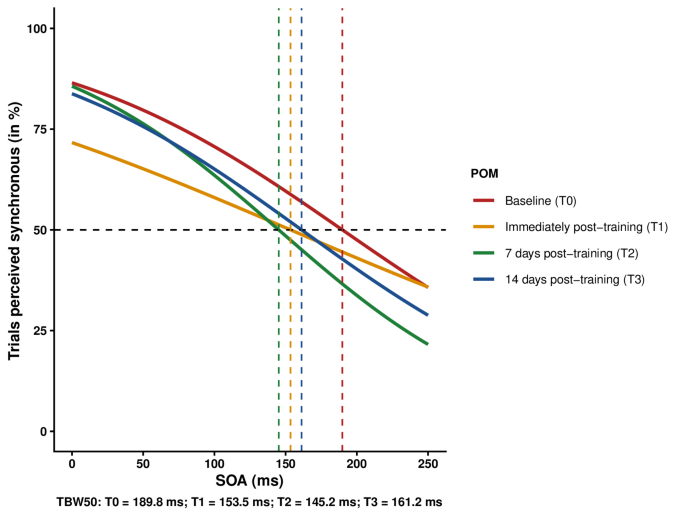
A brief simultaneity judgment task (SJT) with feedback as the training paradigm was administered to a sample of autistic participants (aged 8–17). Simple audiovisual integration and speech comprehension were assessed before training (T0), immediately (T1), seven (T2) and 14 days (T3) after training. For simple audiovisual stimuli, changes in simultaneity judgements were observed at T1 and T2.
At T1, these changes may reflect a shift in response criteria, whereas at T2, a narrower TBW and a steeper slope may indicate improved simultaneity perception. In a Word Recognition Task (WRT), no significant improvements were observed. This study suggests that multisensory training alters simultaneity judgement in a SJT in autistic youth, with the effects persisting seven days.
Future studies should determine whether these effects reflect changes in response criteria or genuine improvements in simultaneity perception and determine how training paradigms must be adapted to enhance speech comprehension in autistic youth. In order to adequately perceive and interpret environmental cues, information from different sensory modalities must be combined via multimodal integration (MI). This process enables the perception of a coherent, holistic environment1,2.
In comparison with unimodal processing, MI facilitates faster and more accurate perception, localization, and discrimination by combining complementary information and integrating redundant information1. MI is therefore a fundamental ability of our sensory system, providing the foundation for development and maintenance of intact higher perceptual, cognitive, motor, and learning processes1,3,4. Alterations in multisensory perception have been reported in individuals diagnosed with schizophrenia or autism5,6.
In these populations, MI deficits are associated with heightened cognitive demands of stimulus processing7 and an increased the risk of experiencing the environment as inadequately filtered and overwhelming8. In autistic individuals, recent findings suggest that deviations in sensory processing may already be evident in infancy and predict the subsequent development of autistic symptoms or later autism diagnoses9,10. Various authors have argued that multisensory processing plays a central role regarding complex social and cognitive abilities, suggesting that a deeper understanding of MI may broaden the understanding of autism6,11,12.
Extract — continue reading at the source.