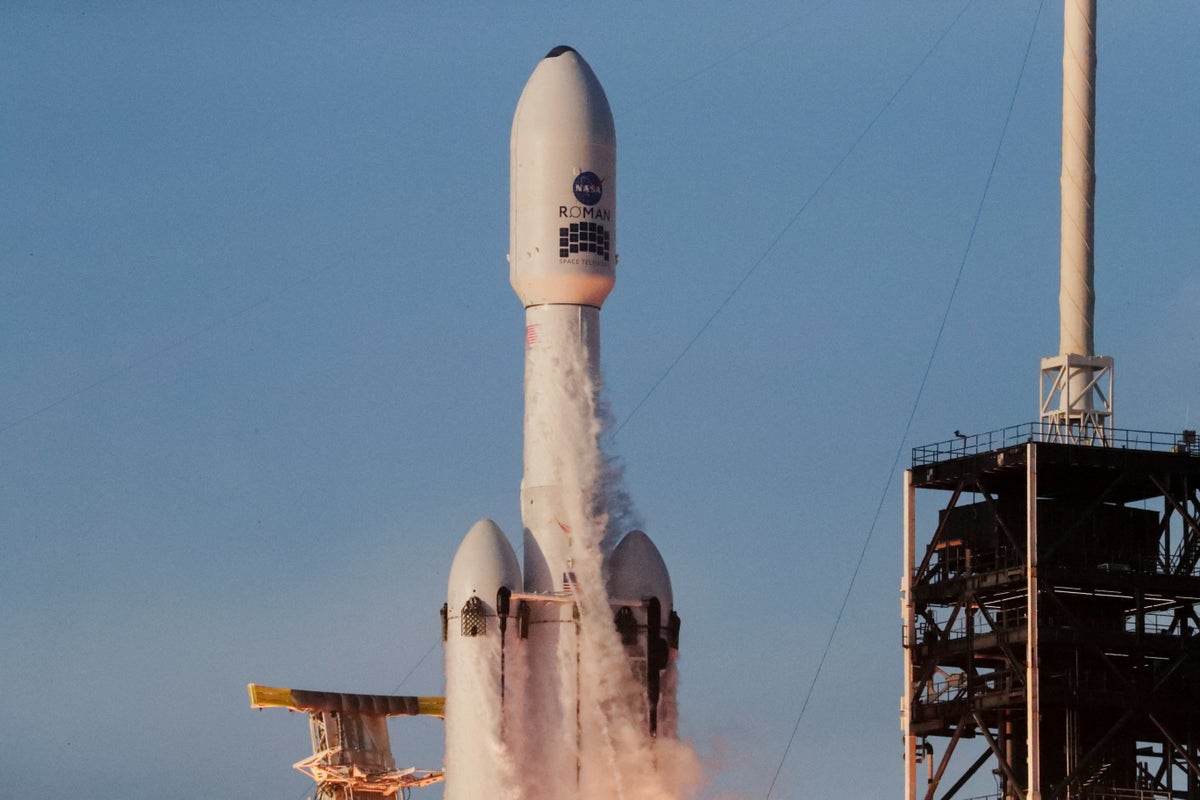
NASA has embarked on an ambitious new endeavour to probe some of the most profound puzzles of space following the launch on Sunday of the US space agency's latest flagship observatory—a repurposed spy satellite designed to capture panoramic views of the cosmos. Lifted into clear blue skies from NASA's Kennedy Space Center in Cape Canaveral, Florida, the roughly $4 billion Nancy Grace Roman Space Telescope was launched aboard a SpaceX Falcon Heavy rocket shortly after sunrise. Its primary mission is planned to last five years, though NASA indicated the spacecraft may hold enough fuel for another five years.
Positioned in an orbit beyond the moon, the telescope is engineered to investigate cosmic enigmas including dark energy and dark matter, while testing gravity across vast scales and searching for exoplanets, the term given to planets outside our solar system. Sunday's launch marked "an endpoint for the engineers, but it's a starting point for the scientists," Julie McEnery, Roman telescope senior project scientist, told reporters at a post-launch news conference. "It feels like I'm on the edge of a precipice, and we're just about to set a foot off into the unknown." The observatory was originally designed for a spy satellite program under the National Reconnaissance Office, a part of the U.S. intelligence community that manages the most powerful American spy satellites.
That program was over budget and terminated, and the NRO in 2012 donated it to NASA, which repurposed it for cosmic exploration. Roman will travel through space toward an orbital location called Lagrange Point 2 about a million miles (1.6 million km) from Earth. Mission scientists will spend the next 90 days commissioning it and preparing for its science operations.
Roman is expected to beam back its first high-resolution images "before the winter holidays," Roman telescope project manager Jackie Townsend said. Roman will build on the capabilities of other orbiting observatories such as the James Webb Space Telescope, launched in 2021, and the Hubble Space Telescope, launched in 1990. "I have no doubt that Roman will become a household name alongside those great instruments of discovery," NASA Administrator Jared Isaacman told reporters.
McEnery has said that Roman possesses broadly the same sensitivity and sharpness of vision as Hubble, but will survey the cosmos more quickly. Roman can survey our entire Milky Way galaxy in a month while Hubble would need a century, according to McEnery. During Sunday's news conference, Isaacman took a call from President Donald Trump and put the phone speaker up to his microphone.
Trump said the launch "looked beautiful on television." "You are doing a fantastic job, and I'm supplying you all that money," Trump said, referring to NASA's approximately $24 billion 2026 budget, which survived an earlier White House proposal to cut the agency's funding by about $6 billion. Trump's administration tried during both his first and second terms as president to cancel Roman or reduce its funding, but Congress preserved it. Its launch came nine months ahead of schedule, according to NASA.
Extract — continue reading at the source.


