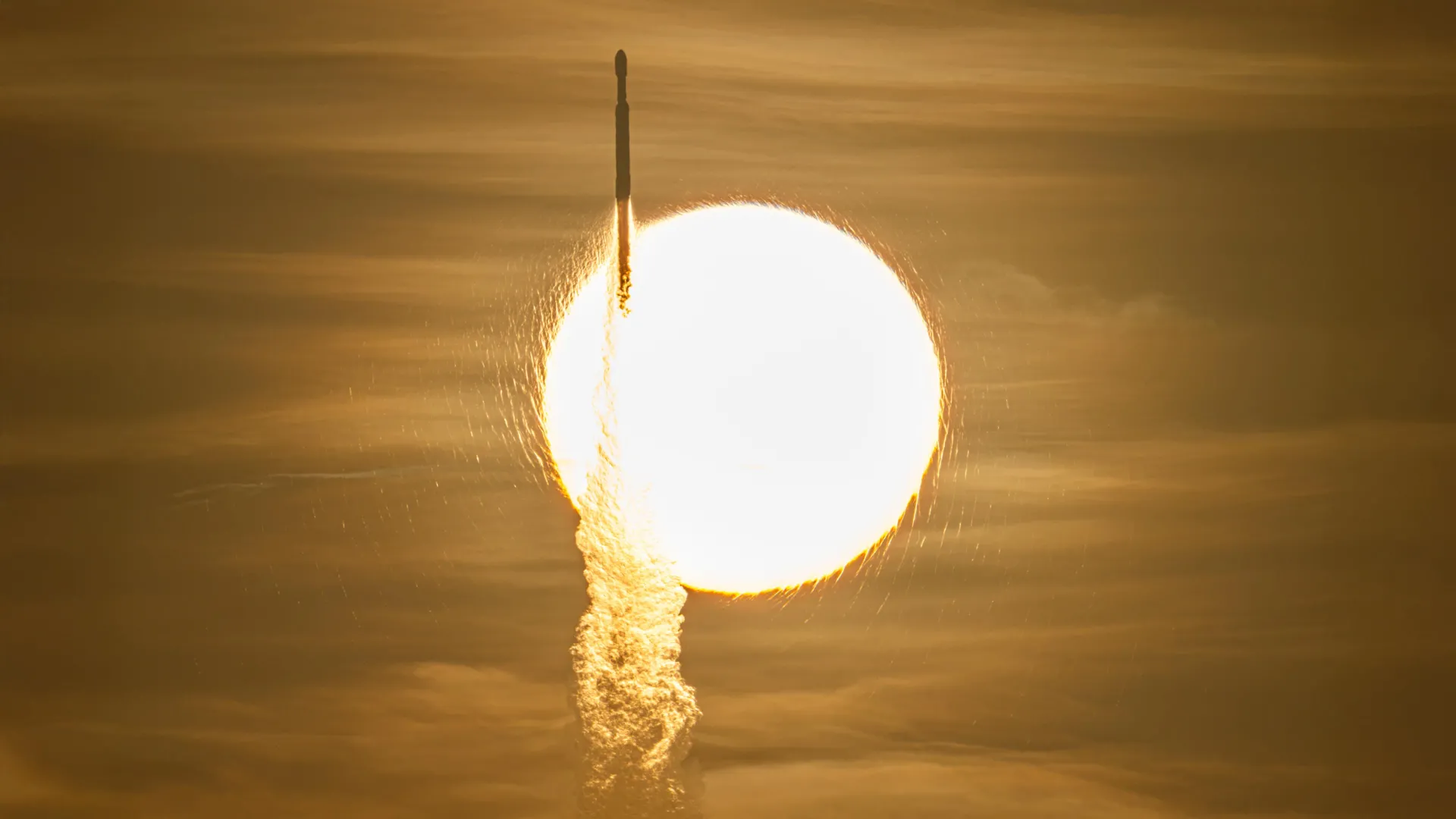
NASA's Nancy Grace Roman Space Telescope has begun a three-month journey covering roughly one million miles as it travels toward its final orbit. The observatory lifted off at 7:26 a.m. EDT Sunday aboard a SpaceX Falcon Heavy rocket from Launch Complex 39A at NASA's Kennedy Space Center in Florida.
Once operational, Roman will combine sharp infrared vision with an unusually wide view of the sky. That combination will allow astronomers to examine enormous regions of space while also looking far back into cosmic history. Among its primary goals are studying dark matter, dark energy, and worlds outside of our solar system, known as exoplanets.
Its sweeping observations are also expected to support many discoveries beyond those central objectives. "Roman is exactly the kind of success story we want to see across NASA," said NASA Administrator Jared Isaacman. "Delivered ahead of schedule and on budget, this mission reflects more than a decade of dedication from the NASA workforce and our industry partners.
Now, Roman will give us a new atlas of the universe, push the boundaries of discovery, and demonstrate what is possible when America's space program pairs bold ambition with disciplined execution." Roman Begins Its Journey Into Deep Space Controllers at NASA's Goddard Space Flight Center in Greenbelt, Maryland, started receiving telemetry from Roman just seven minutes after launch. Falcon Heavy operated as planned and separated from the observatory 31 minutes after liftoff. After detaching from the rocket's center core, the two boosters returned safely to the launch site, where they can be refurbished.
"Roman will be a discovery machine that will bring us closer than ever before to answering humanity's most profound questions about our cosmic history," said Nicky Fox, associate administrator for the Science Mission Directorate at NASA Headquarters in Washington. "With its large field of view and fast survey speeds, Roman will usher us into a new era of discovery and make the invisible visible, setting the foundation for humanity's search for life beyond our solar system." During the first part of the mission, Roman communicates with controllers using the Near Space Network, a system of ground stations and relay satellites that handles tracking, telemetry, and commands. Roughly 70 minutes after launch, communications shift to NASA's Deep Space Network, which will help guide the observatory toward the second Sun-Earth Lagrange point, or L2, about one million miles from Earth.
L2 is a region where the gravitational influences of the Sun and Earth allow spacecraft to maintain a relatively stable position with limited fuel use. Roman will first communicate through the Canberra Deep Space Communication Complex in Australia. Approximately six hours later, communications will transfer to the Madrid Deep Space Communication Complex in Spain and then to the Goldstone Deep Space Communication Complex in California.
Extract — continue reading at the source.