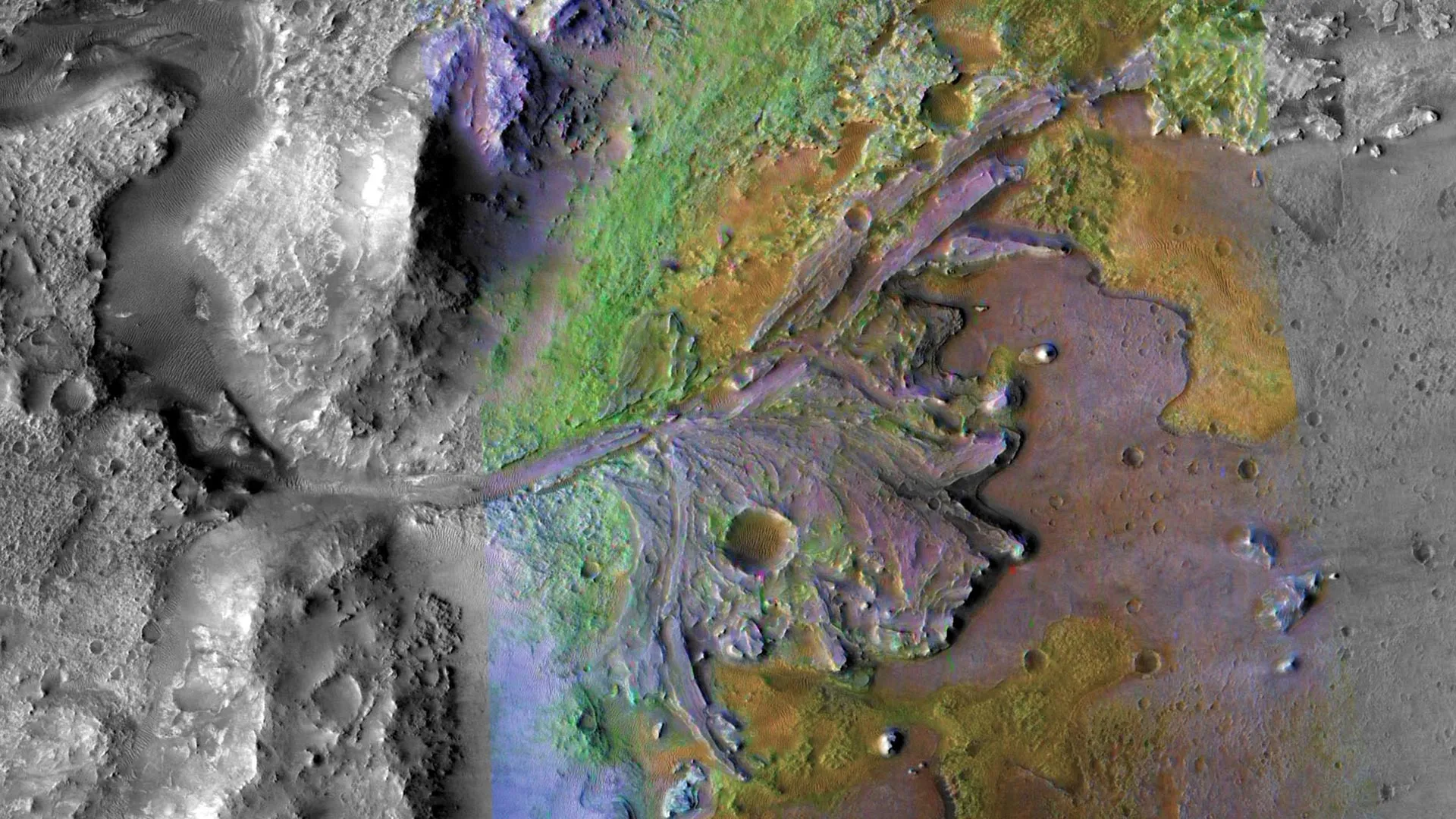
A new study suggests that Jezero Crater's mysterious "Margin Unit" records a far more complicated history of water than scientists expected, involving ancient lakes, groundwater, and later hydrothermal activity. When NASA's Perseverance rover arrived at the inner rim of Mars' Jezero Crater in September 2023, researchers expected to encounter sedimentary rocks along what was once the shoreline of a Martian lake. Such rocks form as layers of material accumulate over long periods of time.
On Earth, sedimentary rocks made from clay and silt can be especially valuable because they are capable of preserving evidence of ancient microbial life. Scientists were also interested in the area because Mars orbiters had detected strong signatures of carbonate minerals there. On Earth, carbonates commonly develop in shallow lakes and oceans, including environments that can support life.
Instead of the expected sedimentary deposits, Perseverance encountered igneous rock. These rocks can form when magma cools underground or when volcanic material solidifies at the surface. Because the minerals inside igneous rocks can preserve information about the conditions present when they formed, they can provide exceptionally detailed geological records.
In the Margin Unit, those rocks revealed an unexpectedly complicated history. The evidence indicates that they interacted with water on at least three separate occasions, and each episode changed their chemistry and physical appearance in different ways. The findings were published in the journal Communications Earth & Environment.
SuperCam Reveals Mars' Hidden Water History Much of this evidence came from SuperCam, an instrument mounted high on Perseverance's mast. SuperCam can identify the mineral composition of geological features by analyzing the light they reflect. When mission scientists identify a promising target, they can direct SuperCam to fire its laser from as far as 21 feet (6.5 meters) away.
The laser creates a small burst of plasma, and the spectrum of that plasma reveals the chemical makeup of the rock. Using this technique, Perseverance has studied more than 185 bedrock targets across the Margin Unit. "Before we arrived at the Margin Unit, the main hypothesis -- derived from orbital observations -- was that the carbonate seen from orbit formed from interaction with the lake that existed in Jezero Crater," said Candice Bedford, a research scientist at Purdue University in West Lafayette, Indiana, and the study's lead author.
Extract — continue reading at the source.


