Galaxies can contain hundreds of billions of stars, but every one of those stars begins with cold, dense gas. Large galaxies, including the Milky Way, are surrounded by an enormous reservoir of this material known as the circumgalactic medium, or CGM. The CGM extends roughly 10-20 times farther than the visible part of a galaxy.
Over time, some of this gas can cool, flow inward, gather into dense clouds, and eventually form new stars. Because stars give rise to planets and the conditions necessary for life, the CGM plays an important role in a galaxy's long term evolution. Yet astronomers have faced a persistent puzzle.
If galaxies are surrounded by so much potential star-forming material, why do they not produce far more stars? Something appears to be preventing much of that gas from cooling and falling inward. Black Hole Jets May Be the Missing Piece A new study led by astronomers Sanchayeeta Borthakur of Arizona State University (ASU) and Namrata Roy, now at the Raman Research Institute (RRI), offers evidence for one possible answer.
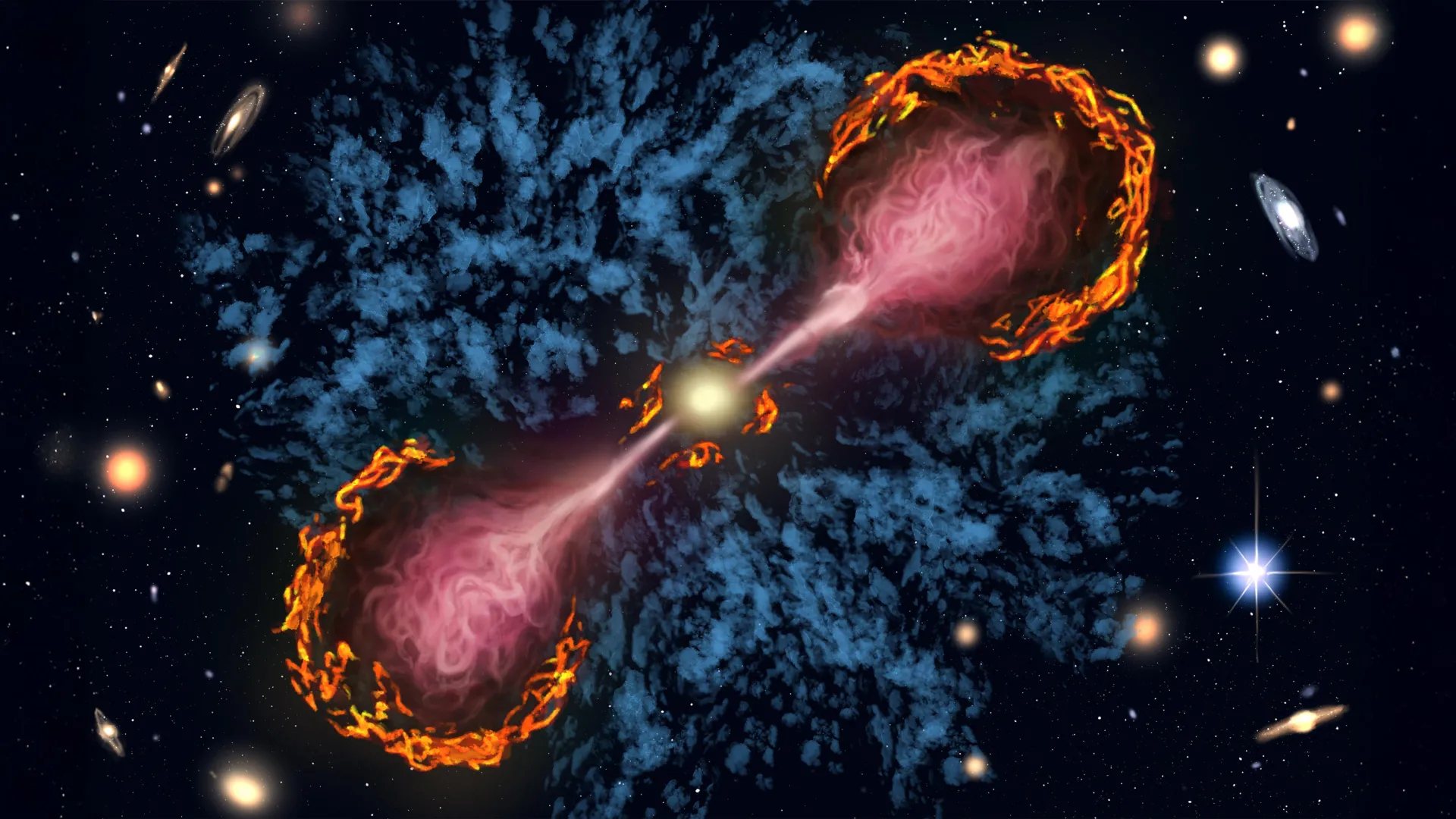
The researchers found that narrow jets of extremely hot plasma launched by supermassive black holes at the centers of galaxies can influence gas far beyond the visible galaxy. These jets may disturb the reservoir of material galaxies depend on for future growth, potentially affecting whether they continue producing stars. The findings were published in the Astrophysical Journal Letters.
"This is a pathbreaking result that solves the long-standing mystery of how black holes influence galaxies, their stars, and life as we know it!" said Borthakur, Associate Professor in ASU's School of Earth and Space Exploration. "This work opens a new direction to explore further the intricacies of the connection between the supermassive black holes trillions of miles from where we are to how we came to be here." When a black hole actively consumes gas, it can release tremendous amounts of energy and heat nearby material. Despite their extraordinary power, these black holes are tiny compared with their host galaxies.
A supermassive black hole can be roughly comparable in scale to our solar system, while the galaxy around it may contain about 100 billion solar systems. "The surprising question is: how can something so small energetically impact something so enormous?" said Roy, assistant professor at RRI and former ASU Exploration Prize Postdoctoral Fellow. The scale of that influence can be difficult to picture.
Extract — continue reading at the source.


