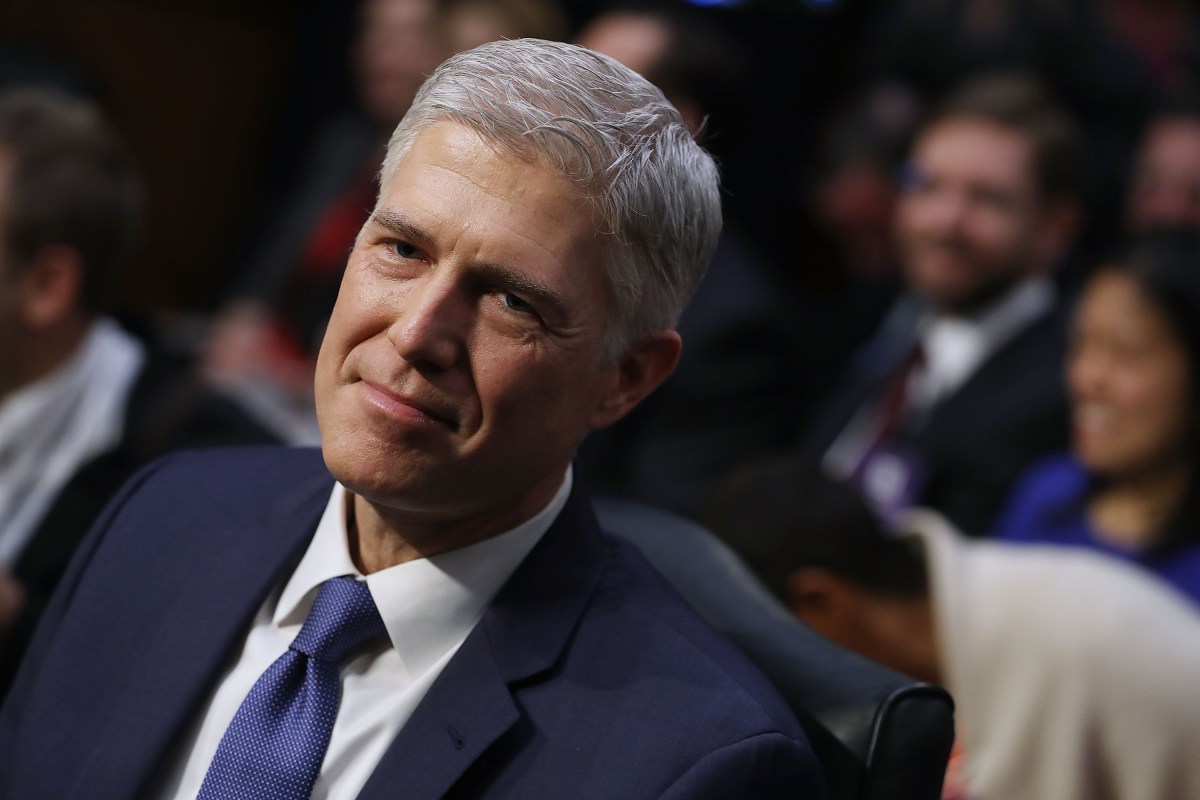
Supreme Court Justice Neil Gorsuch paused oral arguments on Wednesday to correct a comment Sopan Joshi, assistant to the solicitor general, made regarding something the Court said. The case, Department of the Air Force v. Prutehi Guahan, an environmental group, focuses on the central question of whether the Air Force should have to get an environmental study done before applying for a permit to burn old explosives and munitions.
The Air Force argued they shouldn’t need to do the study in order to apply for the permit, while Prutehi Guahan argued that there are risks to Guam’s water supply and endangered species and agencies need to have all the information about environmental impacts when they make the decision about the permit. Early in the oral arguments, Joshi argued that two statutes enacted by Congress are inconsistent. He said the Resource Conservation and Recovery Act (RCRA) requires environmental analysis at various stages of the permit process, thereby displacing the National Environmental Policy Act (NEPA).
Gorsuch said the Supreme Court usually asks people to comply with both of Congress’ commands if they can. Joshi responded that he didn’t think the norm was “that absolute” and started to make an argument about what should happen when a “more specific statute is inconsistent with a general one.” Gorsuch cut him off and said, “I didn’t say ‘inconsistent,’ Counsel. I said if you can do both, there’s no conflict and we try to reconcile and obey all of Congress’ commands.” For decades, the Air Force has used Tarague Beach to get rid of old munitions and explosives, and in 2021, the agency applied for a permit to continue doing so.
When the Air Force applied for the permit, it followed protocol under RCRA, but Prutehi Guahan argued that the agency also has to comply with NEPA. Under NEPA, federal agencies have to conduct environmental impact studies and allow for public comment before making major decisions. Prutehi Guahan argued the munitions disposal runs the risk of harming the ecosystem and threatens water resources.
Government attorneys, though, have argued that following RCRA means they don’t have to follow NEPA and therefore didn’t have to get the environmental study before applying for the permit. Attorneys also argued that since the Environmental Protection Agency in Guam hasn’t made a decision on the permit, the lawsuit was filed too early. Treating applications would open the door to lawsuits at every stage of the permitting process, according to government attorneys.
Like Gorsuch, Justice Sonia Sotomayor questioned why NEPA and RCRA couldn't operate in conjunction with one another, and Justice Brett Kavanaugh questioned the practicality of environmental reviews coming only after a decision on the permit was made. "That's just completely counterintuitive," Kavanaugh said. "[It] extends everything and contrary to everything, about trying to get these things done expeditiously." Justice Clarence Thomas also questioned Prutehi Guahan about precedent treating a permitting application as a final agency action, highlighting a potential weakness in the case.
Extract — continue reading at the source.